Публікації · Серія
Publications · Series
Балістичне озброєння
Ballistic weapons
Серія постів про балістичне озброєння була в роботі ще з початку створення каналу.
Це мені, як Одеському Адміну, який живе під портом, дуже болюча та критична тема, але, нажаль, впродовж довгого періоду часу було неможливо доробити повноцінний огляд саме предметної складової для моєї улюбленої тематики каналу «Що? Як? Чому?», бо просвітницька діяльність є, на мою думку, майже настільки ж важливою, як і цілодобовий моніторинг Оперативних загроз, яким наша команда займається вже не перший рік!
❗️Далі йде серія аналітичних, просвітницьких та технічних постів стосовно балістичного озброєння та його особливостей, на які пішло сумарно декілька місяців пошуку та обробки потрібної інформації, так як нескінченні атаки ворога не давали зосередитись на написанні того, що буде нижче.
This series on ballistic weapons has been in the works since the very start of the channel.
As the Odesa admin who lives right next to the port, this is a painful and critical subject for me. For a long time, though, it was impossible to finish a proper substantive review in my favourite format — “What? How? Why?” — because outreach and explanation are, in my view, almost as important as the round-the-clock monitoring of operational threats our team has been doing for years now.
❗️What follows is a series of analytical, educational and technical posts on ballistic weapons and their specifics. It took several months of searching and processing the required information, since the enemy’s endless attacks left little room to concentrate on writing any of it.
Майже уся інформація повторюється декілька разів у різних комбінаціях та з точок зору різних методів — для легшого засвоєння.
У цих постах не висвітлюються методи протидії або їх ефективність.
Приємного читання!
Nearly everything is repeated several times in different combinations and from the angle of different methods — deliberately, so it is easier to absorb.
These posts do not cover countermeasures or their effectiveness.
Enjoy the read.
01
Що вважається балістичним озброєнням
What counts as ballistic weaponry
Перше, що потрібно узагальнити:
❗️Балістичне озброєння — це ракетні системи та ракети, які можуть рухатись по балістичній / квазібалістичній траєкторії.
Серед них також узагальнюються ГП (гіперзвукові), АБ (аеробалістичні), ПКР (протикорабельні ракети), РСЗВ (реактивні системи залпового вогню), ППО (С-300/400) та інші цілі, які можуть* виконувати політ, близький до балістичних ТТХ.
Що таке балістичне ТТХ?
🚀 Ціль робить «Вихід», рухається з набором висоти в напрямку потенційної цілі («Марш») та падає керовано / некеровано по траєкторії, яка задана під час «Маршу». Для новітнього озброєння та гібридів також враховується, що ціль маневрує під час 2/3 руху, корегує напрямок, траєкторію, швидкість та виконує донаведення на останньому фрагменті польоту («Спуск»).
- «Вихід» — зліт ракети з контейнера / ПУ в напрямку цілі з набором швидкості.
- «Марш» — набір швидкості, апогей траєкторії по дузі.
- «Спуск» — зниження цілі з апогею по дузі в напрямку цілі.
Балістичні ракети (узагальнено) відмічаються своєю швидкістю, але точність вони отримали завдяки новітнім технологіям донаведення. У подальшому звертайте увагу на узагальнення «Вихід», «Марш», «Спуск».
Як фіксуються балістичні ракети?
Для прикладу ми будемо брати «математичні» та аеробалістичні (коригуємі) траєкторії польотів.
Прикладом «математичної» балістики може виступати ТОС-1, БМ-21 «Град» або системи «Ураган», «Торнадо», «Смерч», «Вільха» — їх ціль летить по балістичній траєкторії без сильного коригування.
Ці цілі тактичного, нижнього радіусу оперативного рівня не піднімаються за межі фіксування стандартними радарними системами: радіоконтрастний металевий швидкий «Вихід» тубуса в напрямку руху, через відносно маленьку дальність, дає можливість одразу прорахувати сектор загрози та можливе відхилення під час польоту цілей. Загально висота польоту таких цілей не виходить за межі 10 км при максимальній дальності.
Для балістичного озброєння пікова точка «Маршу» є основним характерним параметром польоту по дузі.
❗️Те, що в більш ширшому плані нас сьогодні і, нажаль, на найближчий час цікавить, — це ракети оперативного рівня, тому для швидкого написання постів ми вживаємо «ОТРК напрямок», щоб зекономити секунди.
На відміну від «тактичних» засобів, ці ракети характерні дальністю 200+, експериментально по 1000 км, де межують з БРСД, але на практиці ми розглядаємо: Онікс, Іскандер-М, КН-23, С-400.
- Онікс — стандартно до 300 км
- С-400 — стандартно до 300 км
- Іскандер — стандартно до 500 км
- КН-23 — заявлено до 700 км
ℹ️Для всіх, без виключення, БР (балістичних ракет) є стандартні висоти польотів по траєкторії — це загально незмінна величина, яка закладена в математичній моделі прорахунку польоту ракети під час створення, тестування та модифікацій.
Цей «польотний режим» диктує критичні параметри польоту, які будуть однакові для усіх польотів на фіксовані дистанції з фіксованою ціллю і будуть кратно змінюватись у залежності від дистанції. Тому для, умовно, керованих квазібалістичних польотів з маневруванням та донаведенням на ціль ефективна дальність польоту менша — через втрату ракетою швидкісного потенціалу, в результаті якого може статись «ізльот» і ракета втратить керованість.
Також, умовно, керований політ займає більше часу, бо коригування, маневри та донаведення виконуються з уповільненням: при великій швидкості перед ракетою утворюється плазма через високе тертя о повітря.
Через це Іскандер-М сповільнюється під час «Спуску», якщо виконує донаведення, та його не видно неозброєним оком вночі, бо плазма не утворюється в щільних шарах атмосфери — на відміну від КН-23, яка до модернізації світила плазмою під час «Спуску» через відсутність коригування по цілі і через це мала критично погану для такого рівня ракет влучність.
Зафіксувати «Вихід» цілі ми можемо фізично завдяки 2 факторам:
- 1️⃣ Металева контрастна ціль гарно відбиває радіосканування радарами.
- 2️⃣ Вихід балістичних ракет супроводжується активною роботою розгінних двигунів, що видно в ІЧ-спектрі з супутників.
The first thing to establish:
❗️Ballistic weaponry means missile systems and missiles capable of flying a ballistic or quasi-ballistic trajectory.
The same umbrella covers hypersonic weapons, aeroballistic missiles, anti-ship missiles, MLRS, air-defence systems used against ground targets (S-300/400) and other targets that can* fly a profile close to ballistic performance.
What does a “ballistic profile” mean?
🚀 The target performs a “Launch”, climbs towards the intended target area (“March”), and then falls — guided or unguided — along the trajectory set during the “March”. For modern weapons and hybrids, one also has to account for the target manoeuvring through two thirds of the flight, correcting heading, trajectory and speed, and performing terminal guidance on the final leg (“Descent”).
- “Launch” — the missile leaves the canister / launcher towards the target, accelerating.
- “March” — acceleration and the apogee of the arc.
- “Descent” — the fall from apogee along the arc towards the target.
Ballistic missiles are broadly characterised by their speed, but their accuracy comes from modern terminal-guidance technology. From here on, keep an eye on the three terms: “Launch”, “March”, “Descent”.
How are ballistic missiles detected?
As examples we will take “mathematical” and aeroballistic (corrected) flight paths.
“Mathematical” ballistics is illustrated by TOS-1, BM-21 Grad, or the Uragan, Tornado, Smerch and Vilkha systems — their projectiles fly a ballistic arc without significant correction.
These tactical and lower-operational-range targets do not climb beyond the reach of standard radar systems: the radar-contrast metallic launch out of the tube along the direction of travel, combined with the relatively short range, makes it possible to compute the threat sector and the possible in-flight deviation immediately. As a rule, such targets do not exceed 10 km of altitude even at maximum range.
For ballistic weapons, the peak of the “March” is the defining parameter of the arc.
❗️What concerns us more broadly today — and, sadly, for the foreseeable future — are operational-level missiles. In posts we compress this to “OTRK direction” simply to save seconds.
Unlike “tactical” systems, these missiles are characterised by ranges of 200 km and up, experimentally to 1,000 km, where they border on MRBMs. In practice we deal with: Oniks, Iskander-M, KN-23, S-400.
- Oniks — typically up to 300 km
- S-400 — typically up to 300 km
- Iskander — typically up to 500 km
- KN-23 — declared up to 700 km
ℹ️Every ballistic missile without exception has standard flight altitudes along its trajectory. This is essentially a fixed value, built into the mathematical flight model during design, testing and subsequent modifications.
This “flight mode” dictates the critical parameters, which will be identical for every flight over a fixed distance against a fixed target and will scale with distance. That is why, for nominally controlled quasi-ballistic flights with manoeuvring and terminal guidance, effective range is lower: the missile loses speed potential, and past a certain point it can lose controllability altogether.
A nominally controlled flight also takes longer, because corrections, manoeuvres and terminal guidance are performed while decelerating — at high speed, air friction forms a plasma sheath ahead of the missile.
This is why the Iskander-M slows down during “Descent” when it performs terminal guidance, and why it is not visible to the naked eye at night: the plasma does not form in the denser layers of the atmosphere. The KN-23, before its upgrade, did glow with plasma during descent because it made no terminal corrections — and consequently had accuracy that was critically poor for a missile of that class.
Physically, we can detect the “Launch” thanks to two factors:
- 1️⃣ A metallic, radar-contrast target reflects radar scanning well.
- 2️⃣ A ballistic launch involves the booster motor running at full thrust, which is visible in the infrared spectrum from satellites.
02
Космічна розвідка: фіксація пусків в ІЧ-спектрі
Space-based reconnaissance: detecting launches in the IR spectrum
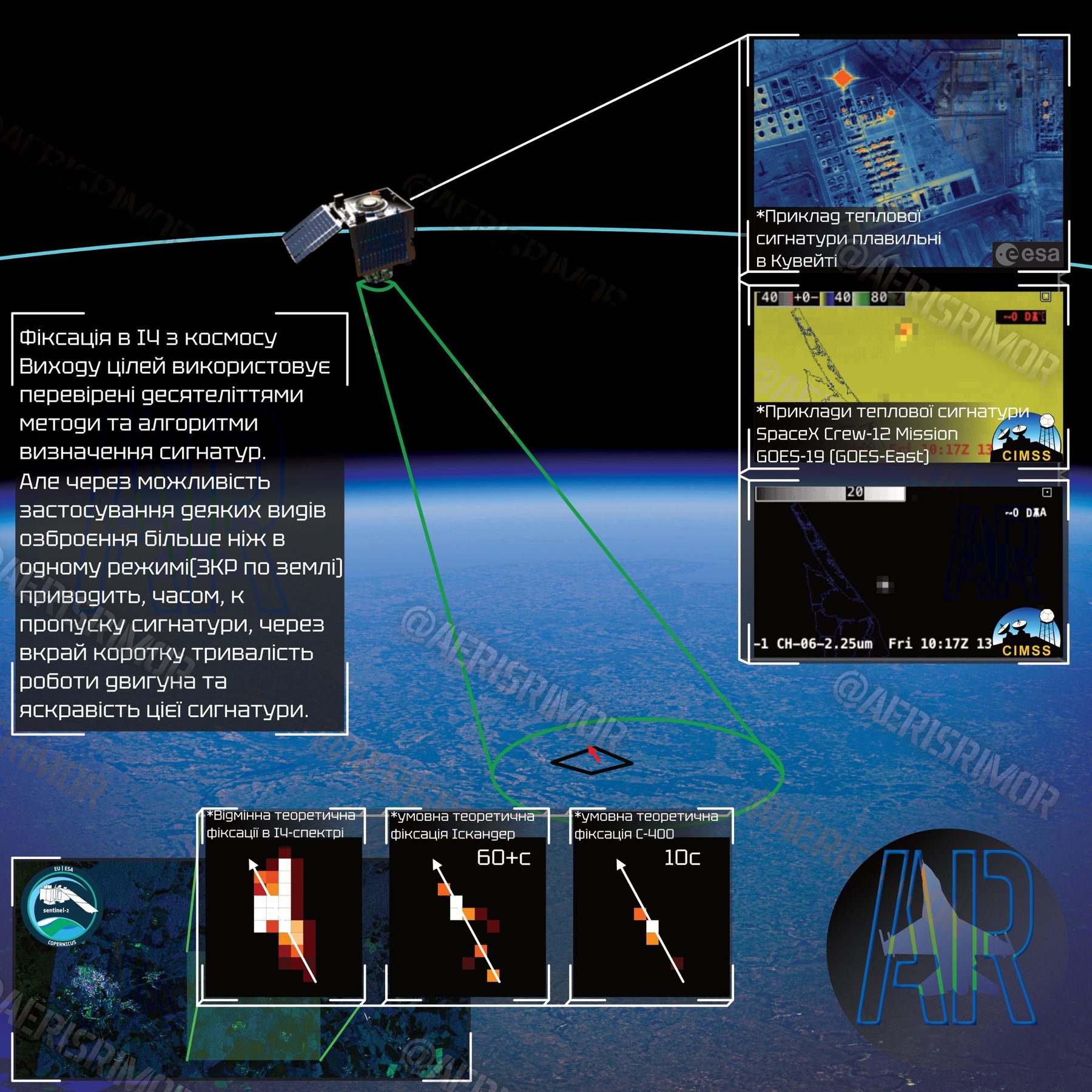
Translation of the annotations on the graphic
Main panel: Infrared detection of a target’s launch from space relies on signature-recognition methods and algorithms proven over decades. But because some weapons can be used in more than one mode (an air-defence missile fired at a ground target), the signature is sometimes missed — the burn is extremely short and the signature correspondingly brief.
Insets, top to bottom: example of the thermal signature of a smelter in Kuwait; examples of the thermal signature of the SpaceX Crew-12 mission as seen by GOES-19 (GOES-East).
Bottom row: an excellent theoretical detection in the IR spectrum; a notional theoretical detection of an Iskander — 60+ s; a notional theoretical detection of an S-400 — 10 s.
❗️Завдяки космічній розвідці ми знаємо про «Виходи» ракет С-400, Іскандер-М, КН-23 з Півночі, Північного Сходу, Сходу, Південного Сходу, Півдня.
*Окремо ми не розглядаємо роботу розвідників та місцевих по інформуванню СОУ. Але отримання фільтрованих та опрацьованих даних потребує часу (до хвилини).
ℹ️Окремо треба враховувати, що для цілей подвійного призначення типу С-400 (інфрачервона сигнатура до 20 с) вже існують «сигнатури», і системі потрібен додатковий час, щоб відфільтрувати, що С-400 летить не по повітряній цілі, а по землі. Це, у свою чергу, через неочікуваність може додати окремі 20 секунд аналізу та помилкового ігнорування алгоритмом сигнатури — але, думаю, що наразі це вже враховано.
Цими факторами і користується противник для швидких ударів, бо наші системи фізично не можуть зафіксувати політ цілей на «Марші» через висоти вище 30 км для оперативних комплексів на дальності від 200 км.
❗️Супутникова розвідка дає не просто попередження. На орбіті Землі БАГАТО супутників, якась кількість із них має подвійне, військове призначення. ІЧ-сигнатура дає не просто сигнатуру виходу, а ще й квадрат ~1,2 км, де знаходиться ПУ, та орієнтовний напрямок «Маршу» ракети (для ракет більше С-400), що технічно надає можливість визначити приблизне розташування комплексів у момент пуску — для їх ураження.
❗️Thanks to space-based reconnaissance we know about the “Launches” of S-400, Iskander-M and KN-23 missiles from the north, north-east, east, south-east and south.
*We are deliberately leaving aside the work of scouts and locals reporting to the Defence Forces. But receiving filtered and processed data takes time — up to a minute.
ℹ️One also has to account for dual-purpose systems such as the S-400 (infrared signature up to 20 s): signatures for them already exist, and the system needs extra time to work out that the S-400 is flying at a ground target rather than an air one. Because of that unexpectedness this can add a separate 20 seconds of analysis, during which the algorithm may erroneously ignore the signature — although by now I believe this has been taken into account.
These are precisely the factors the enemy exploits for rapid strikes, because our systems physically cannot track targets during the “March”: for operational systems at ranges from 200 km the altitudes are above 30 km.
❗️Satellite reconnaissance provides more than just a warning. There are many satellites in Earth orbit, and a share of them are dual-use and military. The IR signature gives not only the fact of a launch, but also a ~1.2 km square containing the launcher and the approximate heading of the missile’s “March” (for missiles larger than the S-400). Technically, that makes it possible to establish the approximate position of the launch systems at the moment of firing — in order to strike them.
03
ДРЛО союзників: що видно з радіогоризонту
Allied AEW&C aircraft: what is visible from the radio horizon
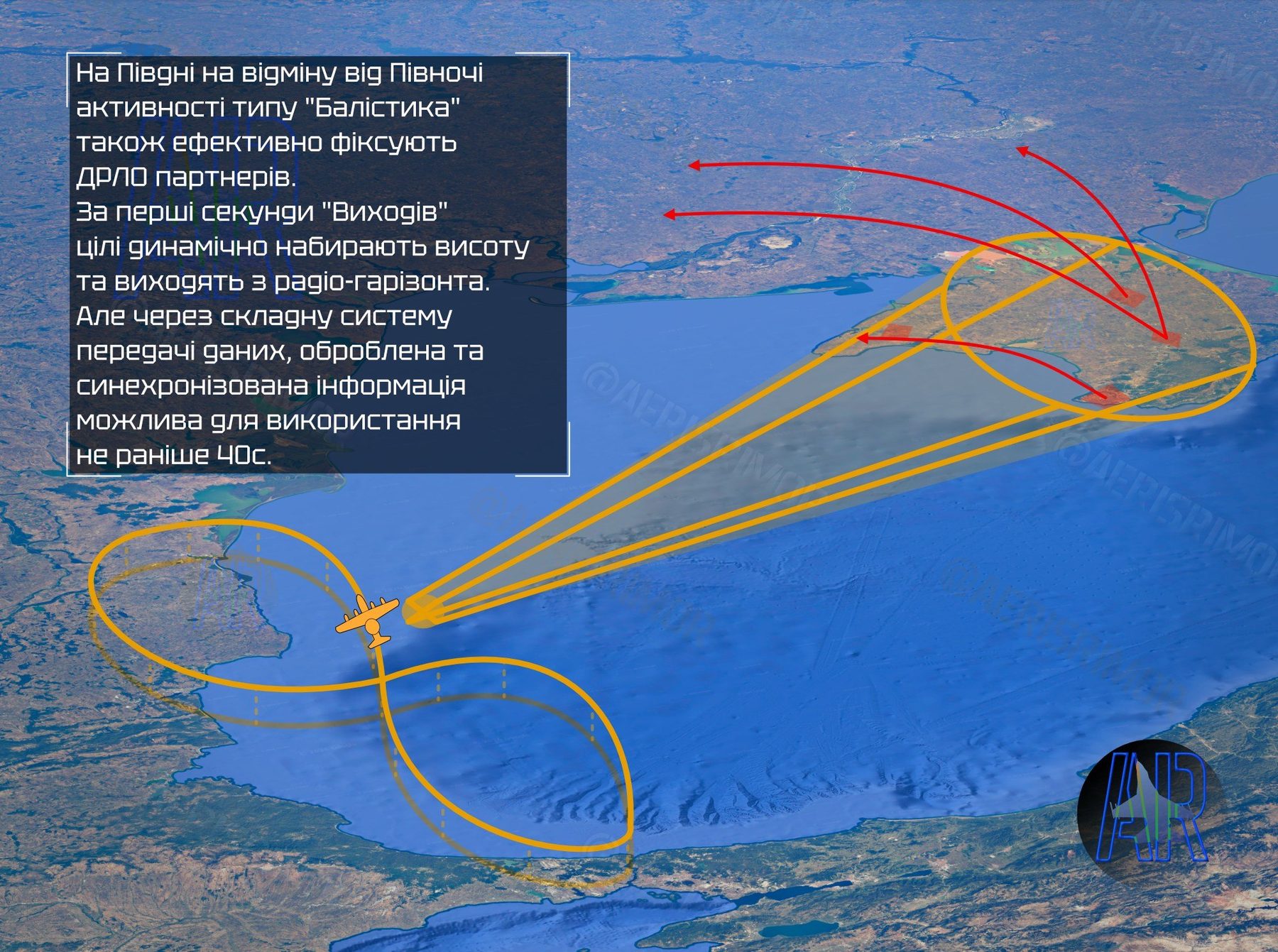
Translation of the annotations on the graphic
In the south, unlike the north, “ballistic”-type activity is also effectively detected by partner AEW&C aircraft. In the first seconds of a “Launch” the targets climb rapidly and rise out of the radio horizon. But because of the complex data-relay chain, processed and synchronised information only becomes usable after roughly 40 seconds.
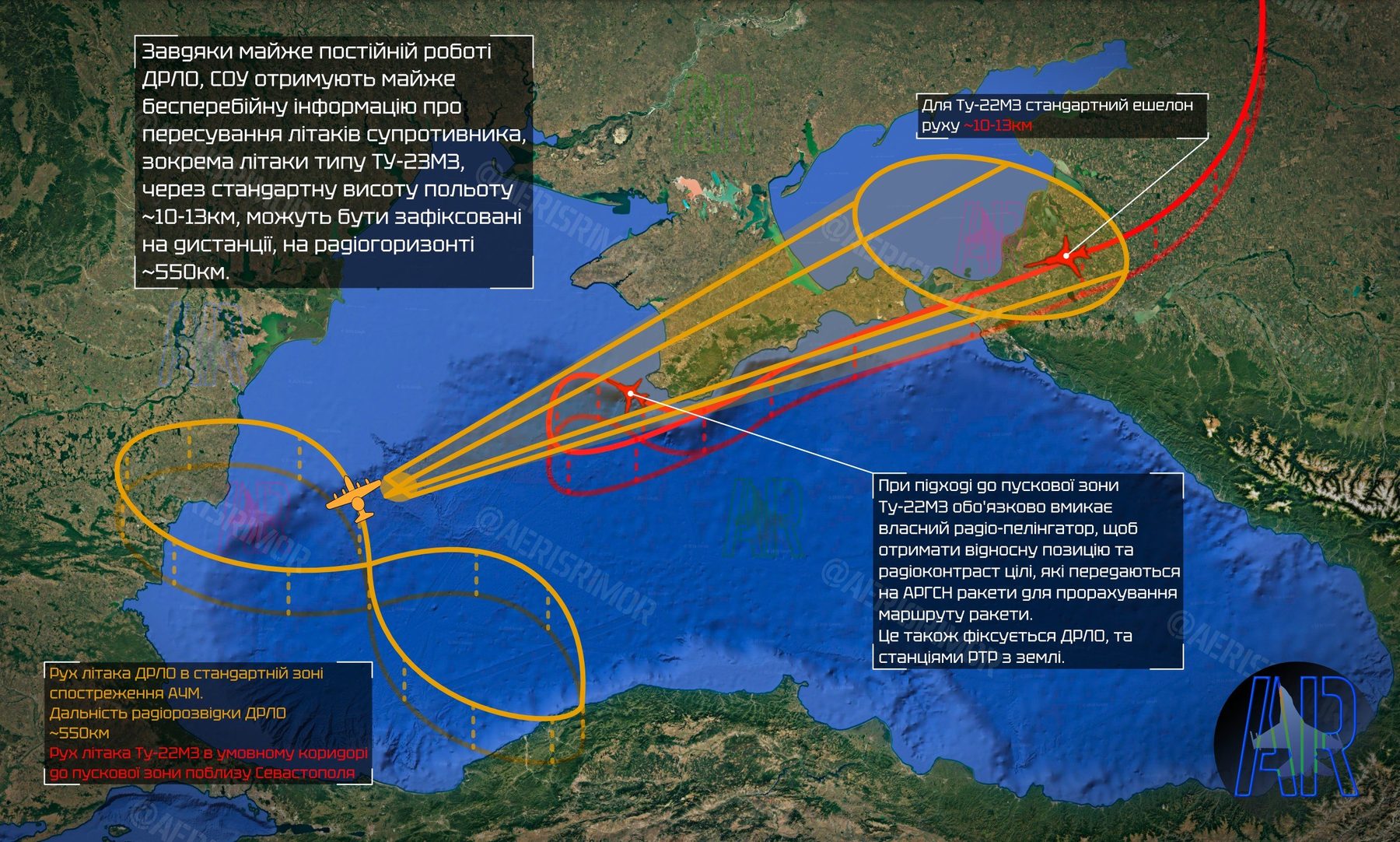
Translation of the annotations on the graphic
Top left: Because AEW&C aircraft are on station almost continuously, the Defence Forces receive nearly uninterrupted information on enemy aircraft movements. Aircraft such as the Tu-22M3, flying at their standard altitude of ~10–13 km, can be detected at range, on the radio horizon, at ~550 km.
Top right: The standard cruising level for a Tu-22M3 is ~10–13 km.
Right: On approach to the launch box the Tu-22M3 must switch on its own radio direction finder to obtain the relative position and radar contrast of the target; these are passed to the missile’s active radar seeker to compute its route. This too is picked up by AEW&C aircraft and by ground-based SIGINT stations.
Legend, bottom left: orange — the AEW&C aircraft’s track in its standard Black Sea patrol area, radar reconnaissance range ~550 km; red — the Tu-22M3’s track along the notional corridor to the launch box near Sevastopol.
❗️Завдяки літакам ДРЛО союзників ми знаємо про «Виходи» Онікс, Іскандер-М (та Іскандер-К, Калібр) на Півдні.
Так як ДРЛО мають фізичне обмеження по дальності розвідки — технічно це радар, який підняли на 12 км, — ефективна дальність роботи фізично обривається на 400–550 км, а параметри «Виходу» цілей є максимально контрастними в порівнянні з повітрям.
*Окремо ми не розглядаємо роботу розвідників та місцевих по інформуванню СОУ. Але отримання фільтрованих та опрацьованих даних потребує часу (до хвилини).
ℹ️ДРЛО також фіксує не тільки «Виходи», а ще й авіацію супротивника: наприклад, Ту-22М3 активно спостерігається від ~Краснодару. Окремо РТР та ДРЛО фіксують обов'язкову активацію бортової РЛС пеленгатора Ту-22М3, якою він сканує радіоконтраст у напрямку цілі для програмування руху ракети та задачі коефіцієнту віддзеркалення випромінювання ціллю, щоб ракета розуміла, як виглядає її ціль у радіоспектрі при підльоті до нас.
❗️Активне спостереження за цілями ДРЛО також є одним з факторів передислокації експериментальних ракетних систем для цілей типу Циркон подалі від ДРЛО партнерів: для швидких атак вони шукають можливості найближчих точок запусків подалі від спостереження, у тому числі ДРЛО, щоб ускладнювати союзникам допомогу нам.
❗️Thanks to allied AEW&C aircraft we know about the “Launches” of Oniks and Iskander-M (as well as Iskander-K and Kalibr) in the south.
AEW&C aircraft have a physical limit on reconnaissance range — technically this is a radar lifted to 12 km — so effective coverage ends at 400–550 km. Within it, the parameters of a “Launch” are about as contrasting against the sky as anything gets.
*We are deliberately leaving aside the work of scouts and locals reporting to the Defence Forces. But receiving filtered and processed data takes time — up to a minute.
ℹ️AEW&C aircraft pick up more than “Launches” — they also track enemy aviation. A Tu-22M3, for instance, is under active observation from roughly Krasnodar onwards. Separately, SIGINT and AEW&C both record the mandatory activation of the Tu-22M3’s onboard direction-finding radar, with which it scans the radar contrast in the direction of the target in order to programme the missile’s flight and set the target’s reflection coefficient — so that the missile knows what its target looks like in the radar spectrum as it approaches.
❗️Active AEW&C surveillance is also one of the reasons experimental missile systems for targets of the Tsirkon class are being redeployed away from partner AEW&C coverage: for rapid attacks they look for the closest launch points that stay out of observation — AEW&C included — in order to make it harder for our allies to help us.
04
Іскандер-М: профіль польоту та час підльоту
Iskander-M: flight profile and time to target
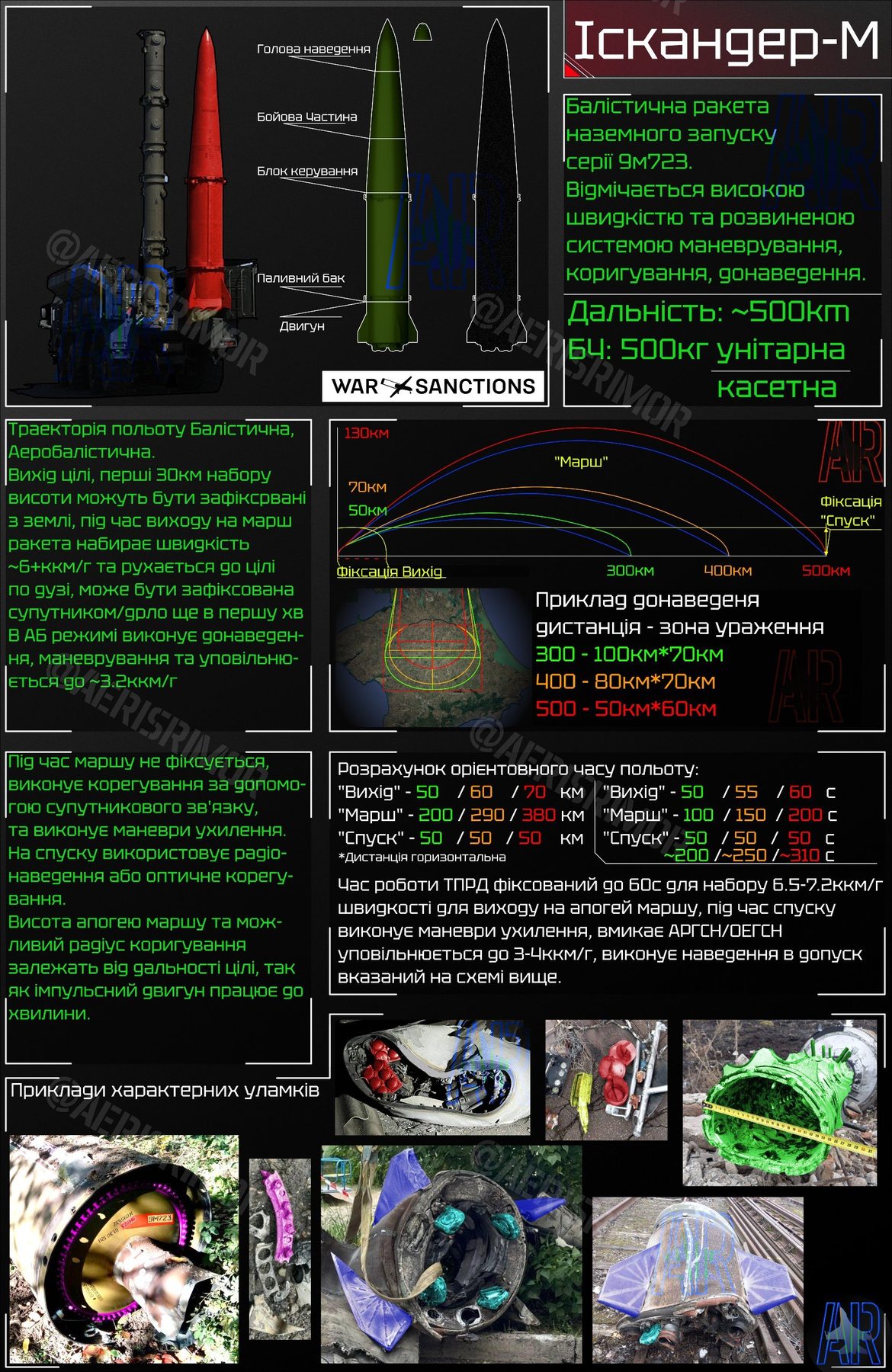
Translation of the annotations on the graphic
Header: Iskander-M — a ground-launched ballistic missile of the 9M723 series. Notable for high speed and a developed system of manoeuvring, correction and terminal guidance. Range: ~500 km. Warhead: 500 kg, unitary or cluster.
Missile callouts: guidance head · warhead · control section · fuel tank · engine.
Left panel: Flight path — ballistic, aeroballistic. The launch and the first 30 km of climb can be detected from the ground; entering the march the missile accelerates to ~6+ thousand km/h and travels along the arc, and can be picked up by satellite or AEW&C within the first minute. In aeroballistic mode it performs terminal guidance and manoeuvres, decelerating to ~3.2 thousand km/h.
Trajectory chart: apogees of 130 / 70 / 50 km for ranges of 500 / 400 / 300 km; “Launch” detection at the start, “Descent” detection at the end.
Terminal-guidance envelope: range — engagement box: 300 km — 100×70 km; 400 km — 80×70 km; 500 km — 50×60 km.
Lower-left panel: During the march the missile is not tracked; it corrects via satellite navigation and performs evasive manoeuvres. On descent it uses radar or optical correction. March apogee and the possible correction radius depend on range, since the impulse engine runs for up to a minute.
Timing panel: “Launch” — 50 / 60 / 70 km, 50 / 55 / 60 s. “March” — 200 / 290 / 380 km, 100 / 150 / 200 s. “Descent” — 50 km, 50 s. Totals: ~200 / ~250 / ~310 s (distances are horizontal). The solid-fuel motor burns for a fixed period of up to 60 s to reach 6.5–7.2 thousand km/h for the march apogee; on descent the missile performs evasive manoeuvres, switches on its active-radar or optical seeker, slows to 3–4 thousand km/h and guides itself into the envelope shown above.
Bottom: examples of characteristic debris.
❗️Іскандер-М. Балістичні ракети серії 9М723 — це основна зброя супротивника для точкової раптової атаки.
Вона має декілька автоматичних режимів виконання польоту та маневрів, ми розглядаємо обидва одразу — рішення про маневри бортова система приймає самостійно. При виборі оператором найшвидшого режиму (звичайний балістичний) ціль летить по математичній траєкторії дуги, що робить її передбачуваною; через це стандартним режимом зараз є аеробалістичний.
Умовно керований аеробалістичний політ триває довше математичної дуги, але складні маневри та можливий відстріл пасток роблять ціль складною для перехоплення.
❗️Загально політ починається з «Виходу»: ракета вмикає ТПРД (твердопаливний ракетний двигун) та перші 50–60 с польоту набирає швидкість. Горизонтально час роботи двигуна і набору швидкості займає ~50 км; ракета перестає фіксуватись наземними засобами через перші 20–30 с після початку розгону, через атмосферну перепону.
Загально від висоти ~30 км і після апогею дуги йде «Марш». Під час «Маршу» ракету вкрай складно пеленгувати з землі, бо, так як траєкторія балістична — це дуга, ракета виходить на апогей (пряма залежність з дальністю польоту: чим більше, тим вище). Швидкості на «Марші» — 6,2–7,5 ккм/год, або 2–2,5 км/с.
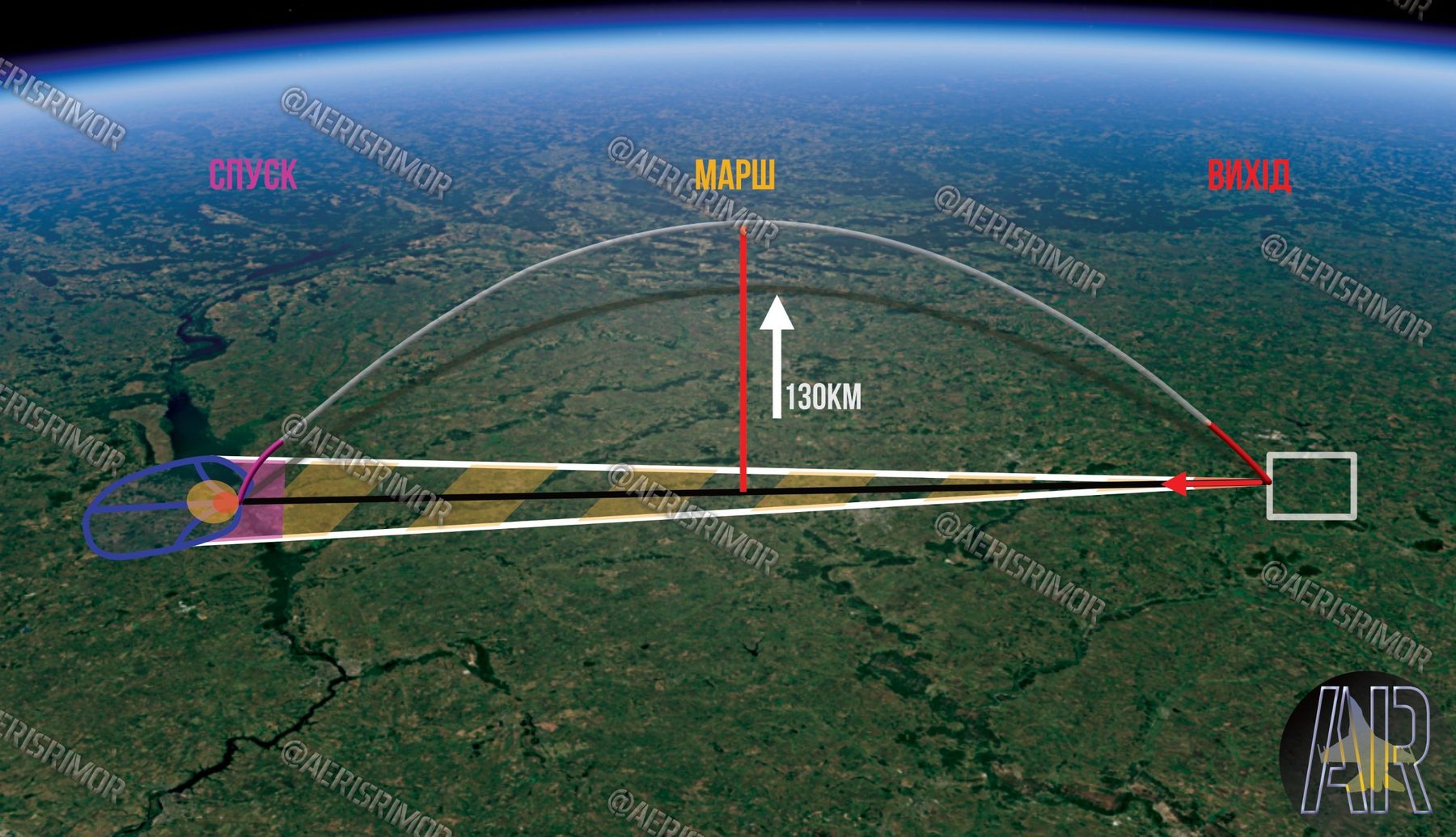
❗️Для 300 км дальності цілі апогей маршу проходить ~40–50 км, 400 км — ~60–70 км, 500 км — ~110–130 км. Це найдовша частина польоту.
Під час «Маршу» ракета виконує коригування по супутниковій навігації декількох бендів та маневрує в допуск траєкторії повернення: 300 км — 9°, 400 — 7°, 500 — 4°. Бортовий комп'ютер прокладає маршрут з урахуванням маневрування та «непередбачуваних рухів ухилення».
Після апогею «Маршу» ракета починає «Спуск». Тут головна різниця в тому, що для стандартного балістичного польоту (читай С-400 по землі, старі КН-23) коригування траєкторії «повернення / спуску» не розраховували: через високий тиск та тертя плазмова завада фізично не дає бортовому комп'ютеру автономно виконувати маневри коригування.
Іскандер-М, на відміну від попередніх прикладів, сповільнюється перед поверненням до 2,8–3,2 ккм/год, або 0,8 км/с, щоб використати головку наведення.
*Примітка: для «звичайної» балістичної траєкторії (на схемі виділено синім) з меншим часом польоту також і вища швидкість «повернення» — орієнтовно 4–4,7 ккм/год, або 1,2–1,7 км/с, що також характерно для швидкості «спуску» С-400, бо вона використовує «звичайну» балістичну траєкторію.
Від останніх 50 км польоту починається «Спуск» цілі з уповільненням і маневрами ухилення від ПРО, відстрілом ІЧ-пасток / фольги. 2/3 польоту ціль активно маневрує та постійно коригує свій рух в автоматичному режимі.
Спуск через уповільнення дає ракеті потенціал «докрутити» в потрібну по активній навігації ціль згідно «допуску» (це умовна горизонтальна та продольна дистанція до визначеної цілі відносно точки початку «повернення»; ці маневри на схемах дальності об'єднані в умовне позначення «Глайд»). Для 300 км «допуск» для ураження цілі — це відхилення до 100 км горизонтальне та 70 км по напрямку руху: уповільнення забирає потенційну енергію тертям о повітря, ракета не зможе маневрувати в «квадрат», але рискати в ціль кутовим маневром може на 100 км від точки розрахункової траєкторії «повернення», що робить цей засіб вкрай непередбачуваним.
- Для 400 км допуск — 80 × 70
- Для 500 км допуск — 70 × 50
Ці маневри виконуються автономно та розраховуються комп'ютером згідно даних, отриманих головкою наведення та супутниковою навігацією.
На практиці ми отримуємо інформацію про вихід цілей завдяки супутникам партнерів, бо сигнатура іскандероподібних двигунів гарно задокументована, а досить тривала робота двигуна (50–60 с) дає гарне вікно для спостереження в ІЧ та інших спектрах. Але саме отримання інформації займає додаткові 40–60 с. У разі помилкового зневажання алгоритмом сигнатурою потрібні ще 20 с на повторну обробку.
❗️«Розрахунковий» час підльоту цілей рахується досить просто: відома величина завжди це «Вихід» — 50 км дальності по горизонталі до 50–60 с польоту; «Марш» скалюється по дальності цілі, тобто 100–200 с; «Спуск» займає до хвилини.
- 300 км — ~200 с
- 400 км — ~250 с
- 500 км — ~310 с
❗️Iskander-M. Ballistic missiles of the 9M723 series are the enemy’s main weapon for a sudden precision strike.
It has several automatic flight and manoeuvring modes; we look at both at once, since the onboard system decides on manoeuvres by itself. If the operator selects the fastest mode — plain ballistic — the target follows a mathematical arc, which makes it predictable. That is why the standard mode today is aeroballistic.
A nominally controlled aeroballistic flight lasts longer than the mathematical arc, but complex manoeuvres and the possible release of decoys make the target hard to intercept.
❗️In general the flight begins with the “Launch”: the missile ignites its solid-fuel rocket motor and accelerates for the first 50–60 s. Horizontally, the burn and acceleration take about 50 km; the missile stops being tracked by ground-based means some 20–30 s after acceleration begins, because of the atmospheric barrier.
Broadly, from ~30 km of altitude and past the apogee of the arc comes the “March”. During the “March” the missile is extremely hard to track from the ground, because a ballistic trajectory is an arc and the missile reaches apogee — directly proportional to range: the longer the flight, the higher it goes. Speeds during the “March” are 6.2–7.5 thousand km/h, or 2–2.5 km/s.
❗️For a target at 300 km the march apogee is ~40–50 km; at 400 km — ~60–70 km; at 500 km — ~110–130 km. This is the longest part of the flight.
During the “March” the missile corrects itself using satellite navigation across several bands and manoeuvres within the tolerance of its re-entry path: 9° at 300 km, 7° at 400 km, 4° at 500 km. The onboard computer plots the route allowing for manoeuvring and “unpredictable evasive movements”.
After the march apogee the missile begins its “Descent”. The key difference here is that for a standard ballistic flight — read: an S-400 fired at a ground target, or older KN-23s — corrections to the re-entry/descent path were never calculated: under high pressure and friction, plasma interference physically prevents the onboard computer from performing correction manoeuvres autonomously.
The Iskander-M, unlike those earlier examples, slows before re-entry to 2.8–3.2 thousand km/h, or 0.8 km/s, in order to use its guidance head.
*Note: for the “plain” ballistic trajectory — marked blue on the diagram — flight time is shorter and re-entry speed correspondingly higher, roughly 4–4.7 thousand km/h, or 1.2–1.7 km/s. The same is typical of the S-400’s descent speed, since it uses a “plain” ballistic path.
The last 50 km of the flight are the “Descent”, with deceleration, evasive manoeuvres against missile defence, and the release of IR decoys and chaff. Through two thirds of the flight the target manoeuvres actively and continuously corrects its course automatically.
Because it decelerates, the descent gives the missile the energy budget to “crank” onto the target designated by active navigation, within its “tolerance” — the notional lateral and longitudinal distance to the designated target relative to the point where re-entry begins. On the range diagrams these manoeuvres are grouped under the label “Glide”. For 300 km, the tolerance for hitting the target is a deviation of up to 100 km laterally and 70 km along the direction of travel: deceleration bleeds off potential energy through air friction, so the missile cannot manoeuvre across the whole “box”, but it can yaw onto the target with an angular manoeuvre up to 100 km from the calculated re-entry point — which makes this weapon extremely unpredictable.
- At 400 km the tolerance is 80 × 70
- At 500 km the tolerance is 70 × 50
These manoeuvres are performed autonomously and computed onboard from data supplied by the guidance head and satellite navigation.
In practice we learn about launches thanks to partner satellites, because the signature of Iskander-type motors is well documented, and a fairly long burn (50–60 s) gives a good observation window in the infrared and other spectra. Obtaining that information, however, takes an additional 40–60 s. If the algorithm mistakenly dismisses the signature, another 20 s are needed to reprocess it.
❗️The “calculated” time to target is simple arithmetic: the known constant is always the “Launch” — 50 km of horizontal distance over 50–60 s of flight; the “March” scales with the range to the target, i.e. 100–200 s; the “Descent” takes up to a minute.
- 300 km — ~200 s
- 400 km — ~250 s
- 500 km — ~310 s
05
Бойові частини: унітарна та касетна
Warheads: unitary and cluster
Маленька зноска по БЧ.
Унітарна та касетна мають приблизно однакову масу — 500 кг. Унітарна — варіації фугасу ~500 кг. Касетна виконує повітряний підрив на висоті в районі 1–1,5 км; у залежності від вектору заходу на ціль це:
- 1️⃣ Вертикально — коло радіусом ~100 м.
- 2️⃣ Кутом — еліпс до 200 × 100 м.
Касетний варіант БЧ використовує вибивний заряд у повітрі: через відцентрову силу і оберти по осі рівномірно розкидає 54 заряди в радіусі ураження.
Маса 1 касети ~0,5 кг; після падіння може підстрибнути на пару метрів для підриву на більший радіус, обладнана елементами ураження, які перпендикулярно розраховані на пробив 100 мм броні.
Підсумовуючи: Іскандер-М та інша балістична зброя залишаються, на даний момент, зброєю майже* гарантованого ураження (чогось у радіусі — наведення не завжди працює, або не завжди є). Через що є КРИТИЧНИМ фактором для реагування, бо час підльоту рахується хвилинами.
A short footnote on warheads.
The unitary and cluster versions weigh roughly the same — 500 kg. The unitary one is a ~500 kg high-explosive variant. The cluster warhead detonates in the air at around 1–1.5 km; depending on the approach vector to the target this gives:
- 1️⃣ Vertical — a circle with a radius of ~100 m.
- 2️⃣ At an angle — an ellipse of up to 200 × 100 m.
The cluster warhead uses an expelling charge in the air: centrifugal force and axial rotation distribute 54 submunitions evenly across the effective radius.
Each submunition weighs ~0.5 kg. After hitting the ground it can bounce a couple of metres to detonate over a wider radius, and it carries penetrators designed to punch through 100 mm of armour on perpendicular impact.
In summary: the Iskander-M and other ballistic weapons remain, for now, weapons of near-guaranteed effect (on something within the radius — guidance does not always work, and is not always there). Which makes them a CRITICAL factor for response, because time to target is measured in minutes.
06
Схеми: як це виглядає з землі на 300, 400 та 500 км
The diagrams: how it looks from the ground at 300, 400 and 500 km
У цих схемах ми розглядаємо СУТО Іскандер-М ціль — як з нею можливо працювати з землі. Наведені в розрахунках і схемах числа близькі до реальності, але не є фактичними (тому в них багато «~»).
«Вихід» цілі технічно може бути зафіксований лише в перші пару десятків секунд, бо ми не маємо потужних ЗГРЛС, або заатмосферних радарів, власних ДРЛО, які зможуть патрулювати приграничні області 24/7. Тому більшу частину маршруту цілі не фіксуються — частіше за все ми отримуємо попередження та очікувані напрямки від партнерів.
Коли ви бачите «Вихід» з «Напрямок», можете приблизно візуалізувати, скільки є часу. Якщо вихід був, але фіксації нема — «Марш», значить може бути ~хвилина, і треба швидко сховатись за якоюсь спорудою, приміщенням.
In these diagrams we look strictly at an Iskander-M target — and at what can be done about it from the ground. The figures used in the calculations and diagrams are close to reality, but they are not actual values (hence all the “~” signs).
Technically, a target’s “Launch” can only be detected in the first couple of dozen seconds, because we have no powerful over-the-horizon radars, no exo-atmospheric radars and no AEW&C aircraft of our own able to patrol the border regions 24/7. For most of the route, therefore, targets are not tracked — most often we receive the warning and the expected headings from our partners.
When you see a “Launch” with a heading, you can roughly visualise how much time there is. If there was a launch but no further detection — the “March” — that means you may have about a minute, and you need to get behind a building or into a room fast.
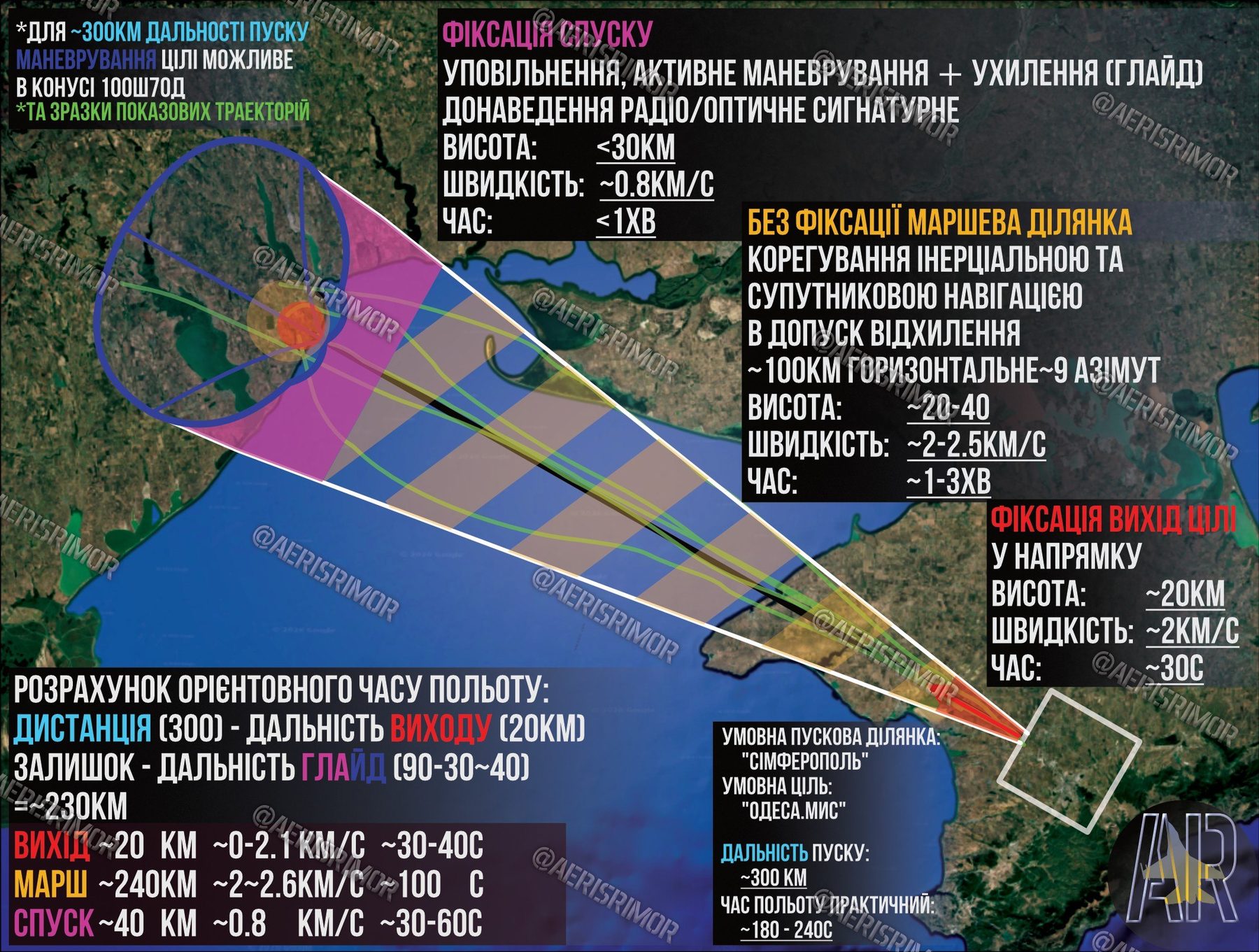
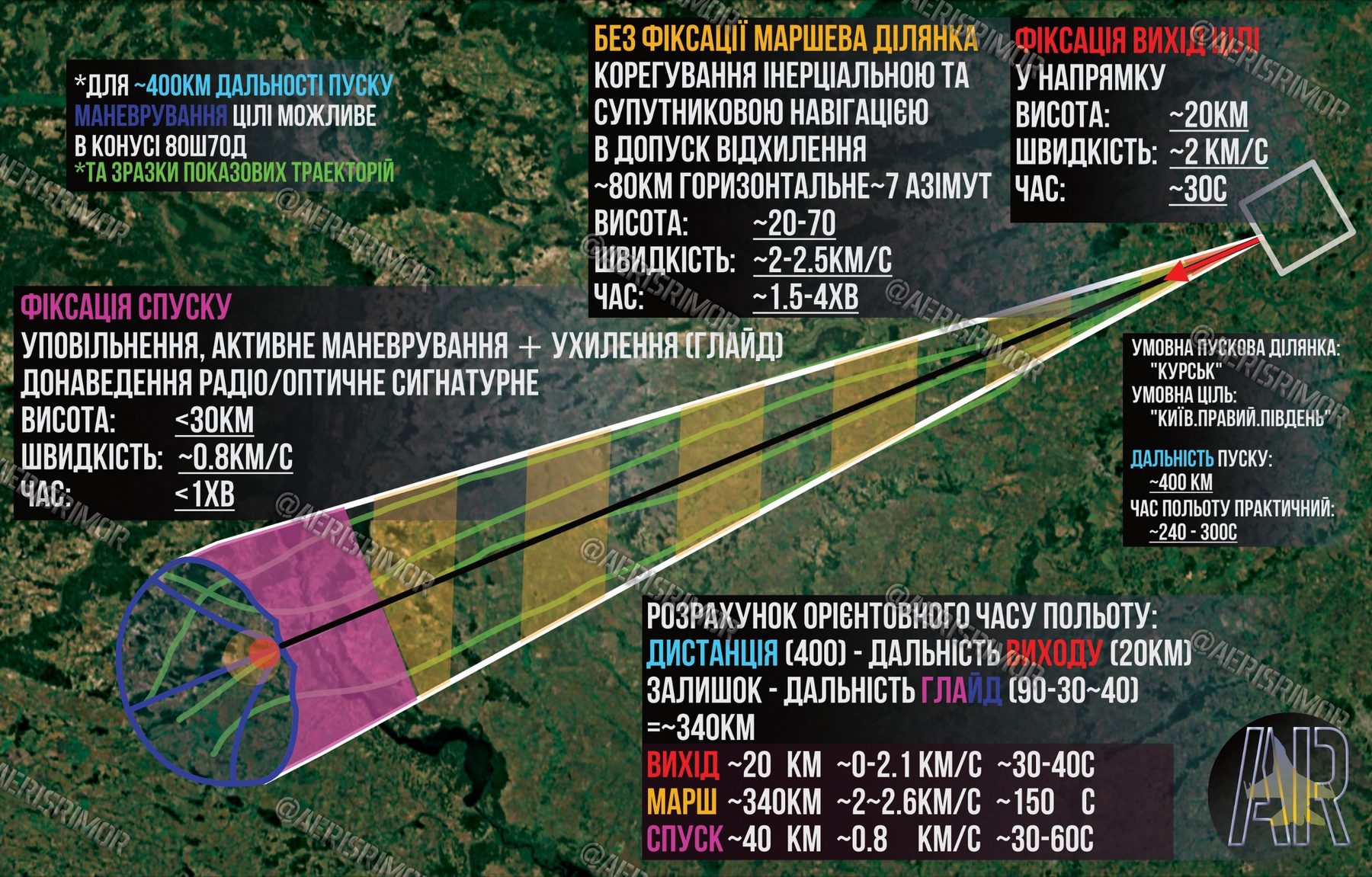
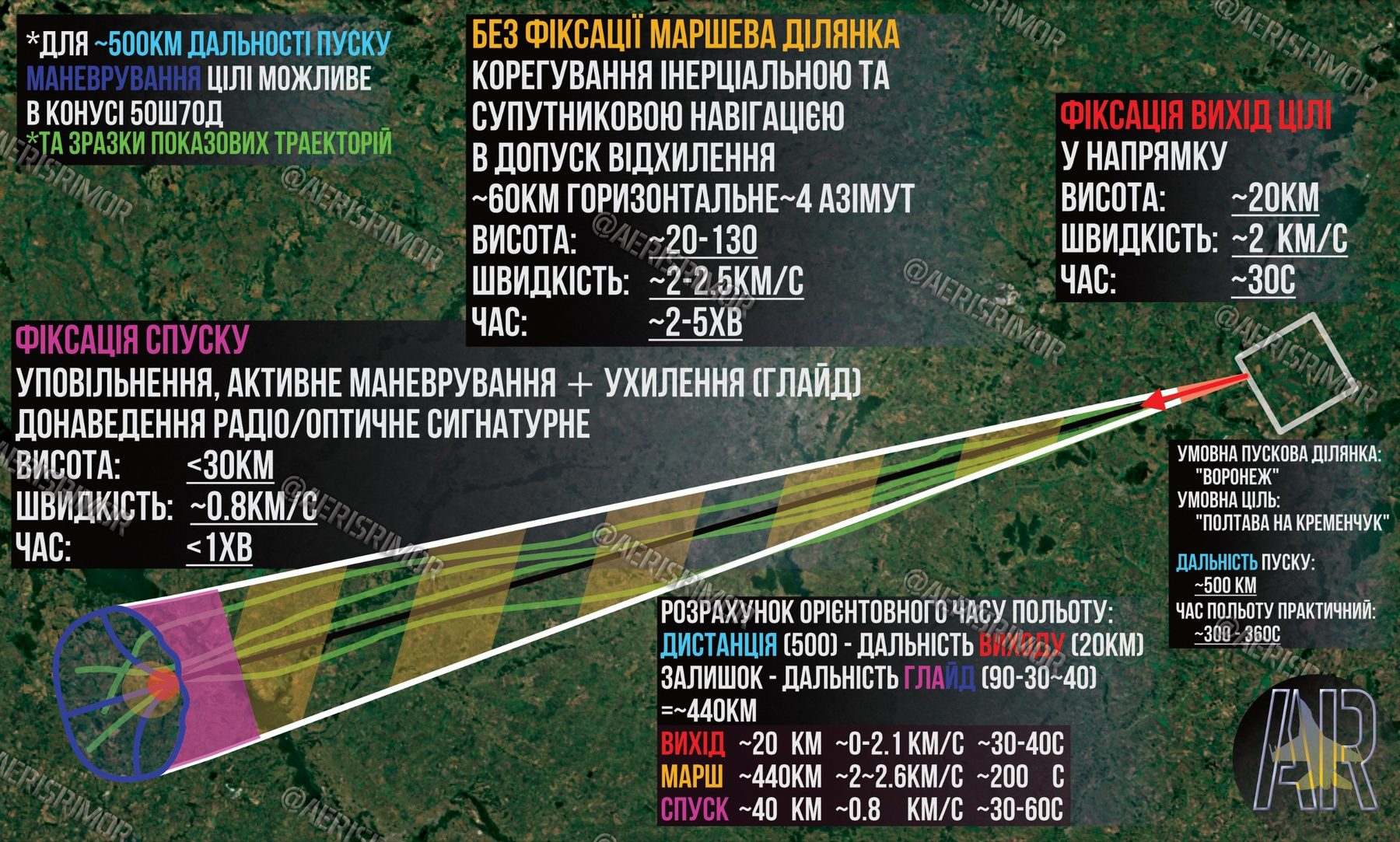
Як читати ці схеми. На непарних схемах — вигляд згори: умовна пускова ділянка, умовна ціль, дальність пуску та практичний час польоту. Блоки підписані так:
- Фіксація «Вихід цілі» — червоним: висота ~20 км, швидкість ~2 км/с, час ~30 с.
- Без фіксації — маршева ділянка — жовтим: коригування інерціальною та супутниковою навігацією в допуск відхилення, висота та швидкість на марші, тривалість.
- Фіксація «Спуску» — рожевим: уповільнення, активне маневрування та ухилення («Глайд»), донаведення радіо/оптичне, висота <30 км, швидкість ~0,8 км/с, час <1 хв.
- Розрахунок орієнтовного часу польоту — сумарний блок унизу: дистанція мінус дальність «Виходу», залишок — дальність «Глайду».
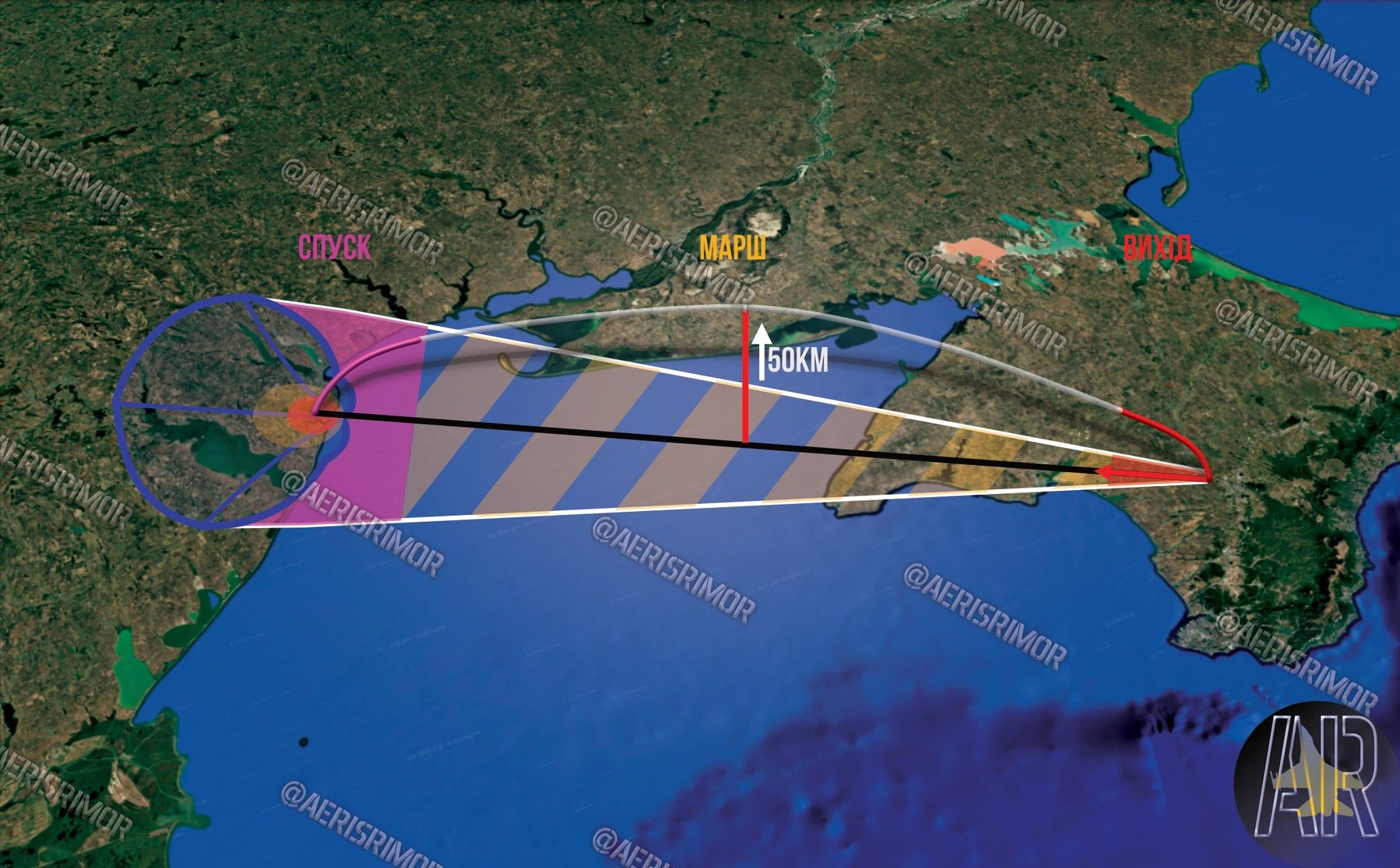
*На парних схемах праворуч ви можете побачити відносну висоту траєкторії польоту цілей — для більш наочної демонстрації процесу польоту.
How to read these diagrams. The odd-numbered ones are the plan view: notional launch area, notional target, launch range and practical flight time. The blocks are labelled as follows:
- “Launch detected” — in red: altitude ~20 km, speed ~2 km/s, time ~30 s.
- “Not tracked — march leg” — in yellow: correction by inertial and satellite navigation within the deviation tolerance, plus altitude, speed and duration on the march.
- “Descent detected” — in magenta: deceleration, active manoeuvring and evasion (“Glide”), radar/optical terminal guidance, altitude <30 km, speed ~0.8 km/s, time <1 min.
- “Approximate flight-time calculation” — the summary block at the bottom: distance minus the “Launch” leg, with the remainder being the “Glide” distance.
*The even-numbered diagrams show the relative altitude of the flight path — a more visual demonstration of the same flight.
Сценарій 1 — ~300 км, «Сімферополь» → «Одеса, мис»
Scenario 1 — ~300 km, “Simferopol” → “Odesa headland”
Сценарій 2 — ~400 км, «Курськ» → «Київ, правий, південь»
Scenario 2 — ~400 km, “Kursk” → “Kyiv, right bank, south”
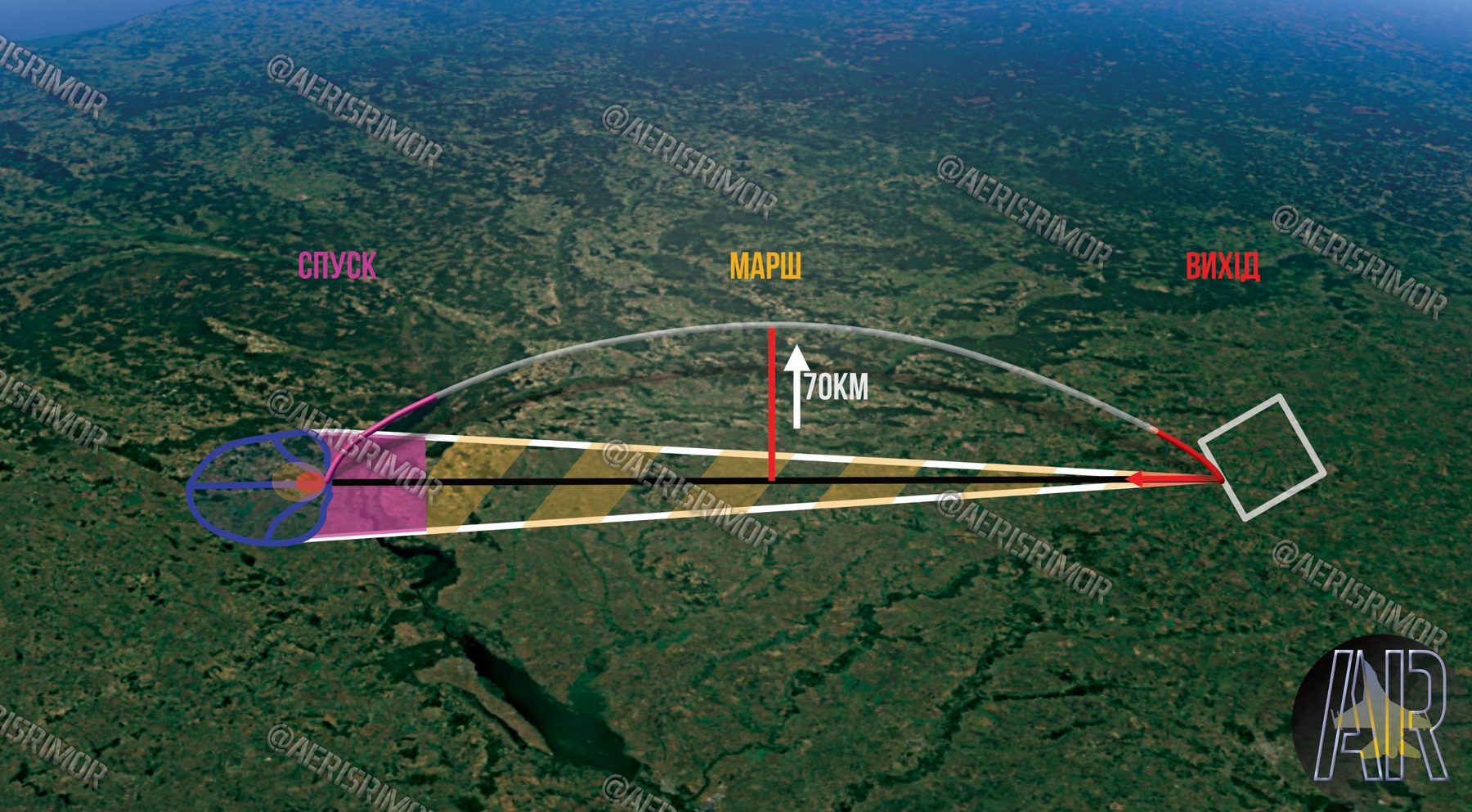
Сценарій 3 — ~500 км, «Воронеж» → «Полтава на Кременчук»
Scenario 3 — ~500 km, “Voronezh” → “Poltava towards Kremenchuk”
Сценарій 4 — ~300 км, «Клинці» → «Київ, центр»
Scenario 4 — ~300 km, “Klyntsi” → “Kyiv, centre”
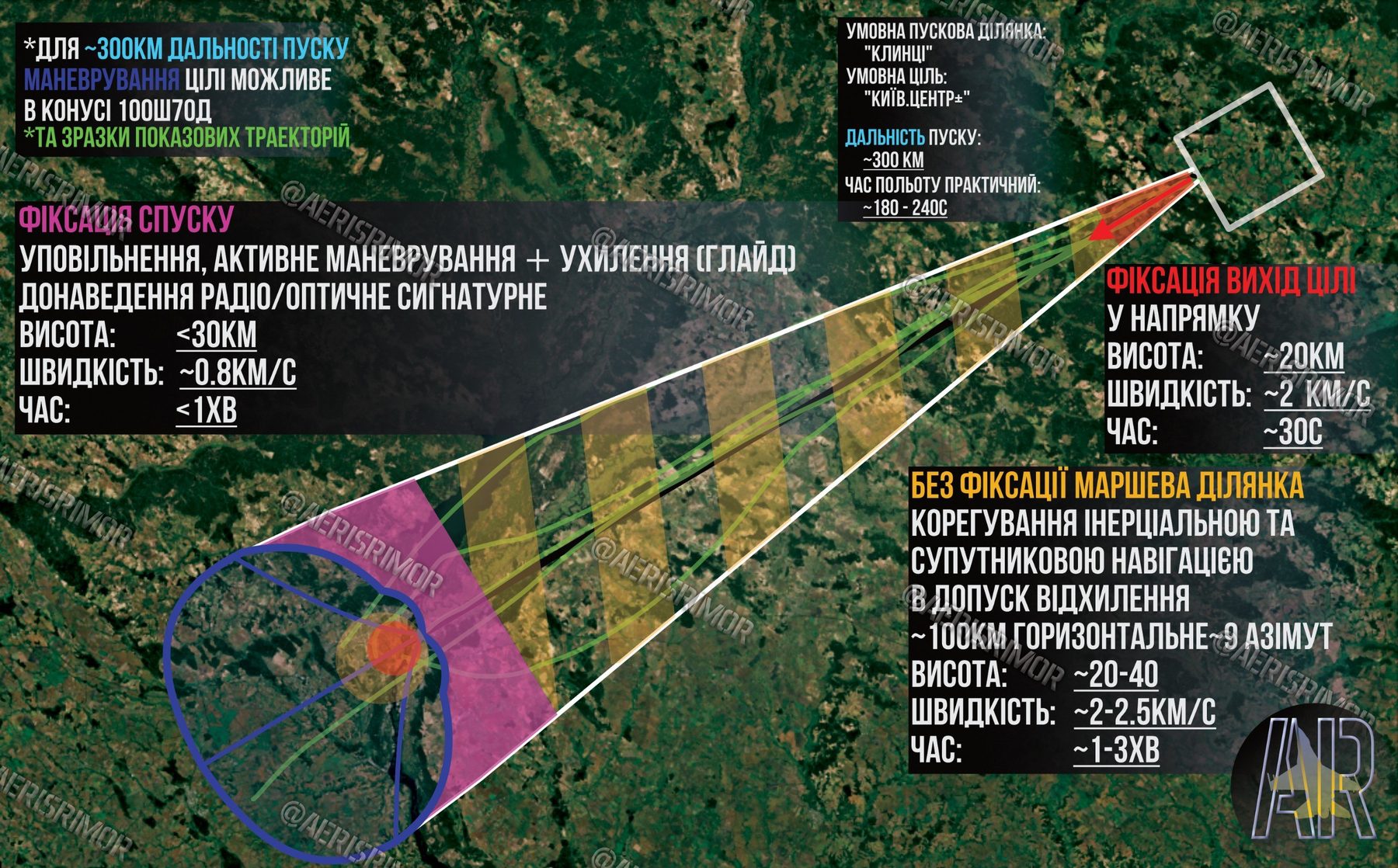
Під час «Спуску» Іскандер може агресивно маневрувати згідно коригування ГСН, виконуючи маневри ухилення. Через це від точки фіксації «Спуск», згідно з дальністю від точки «Вихід», можливе маневрування в умовному радіусі: 100 км (300 км дальності) — 80 км (400 км) — 70 км (500 км). Відповідні відбитки коригування зазначені на схемах вище з прикладом умовних розрахунків згідно приблизних даних, які можна отримати з землі.
Математична траєкторія польоту швидше аеробалістичної, через що умовний «розрахунковий» час підльоту треба враховувати в розбіжності щонайменше 30 секунд від ідеального розрахунку траєкторії. Тому в схемі 300 км зазначено практичний час 180–240 с, хоча ідеальний розрахунковий згідно моделі буде 200. Але, як зазначено вище, внутрішня навігаційна система виконує коригування і маневри весь час польоту, через що умовно ідеальний розрахунок в 200 с можна вважати середнім по тривалості серед усіх можливих траєкторій і, через його математичну суть, він майже ніколи не буде вірним — бо комп'ютер навігації та коригування задає «випадкові» маневри під час польоту.
❗️Також, згідно траєкторій, під час руху цілей на землі чутно «Сонік буми», конус Маха — швидкість цілі перевищує швидкість звука, але з важливим нюансом. Під час руху у верхніх шарах атмосфери конус не доходить до землі, але останню третину перед спуском потенціал ракети пробиває щільні шари атмосфери, приводячи до того, що в Десні, Полтаві, Прилуках чують сонік буми / конус Маха.
During the “Descent” an Iskander can manoeuvre aggressively on corrections from its seeker, performing evasive manoeuvres. As a result, from the point where the “Descent” is detected, and depending on the distance from the “Launch” point, manoeuvring is possible within a notional radius of 100 km (at 300 km range), 80 km (400 km) and 70 km (500 km). The corresponding correction footprints are shown on the diagrams above, together with sample notional calculations based on the approximate data obtainable from the ground.
The mathematical trajectory is faster than the aeroballistic one, so the notional “calculated” time to target must be treated with a spread of at least 30 seconds around the ideal trajectory calculation. That is why the 300 km diagram gives a practical time of 180–240 s, even though the ideal model figure would be 200. As noted above, the internal navigation system corrects and manoeuvres throughout the flight, so the notionally ideal 200 s figure is best treated as the average across all possible trajectories — and, being mathematical, it will almost never be exactly right, because the navigation and correction computer introduces “random” manoeuvres in flight.
❗️Also, given these trajectories, sonic booms — the Mach cone — are audible on the ground as the targets pass: the target is supersonic, but with an important nuance. While it travels through the upper atmosphere the cone does not reach the ground; over the last third before descent, however, the missile’s energy punches through the dense layers, which is why sonic booms are heard in Desna, Poltava and Pryluky.
07
С-400 по землі: сценарій для Києва
S-400 against ground targets: the Kyiv scenario
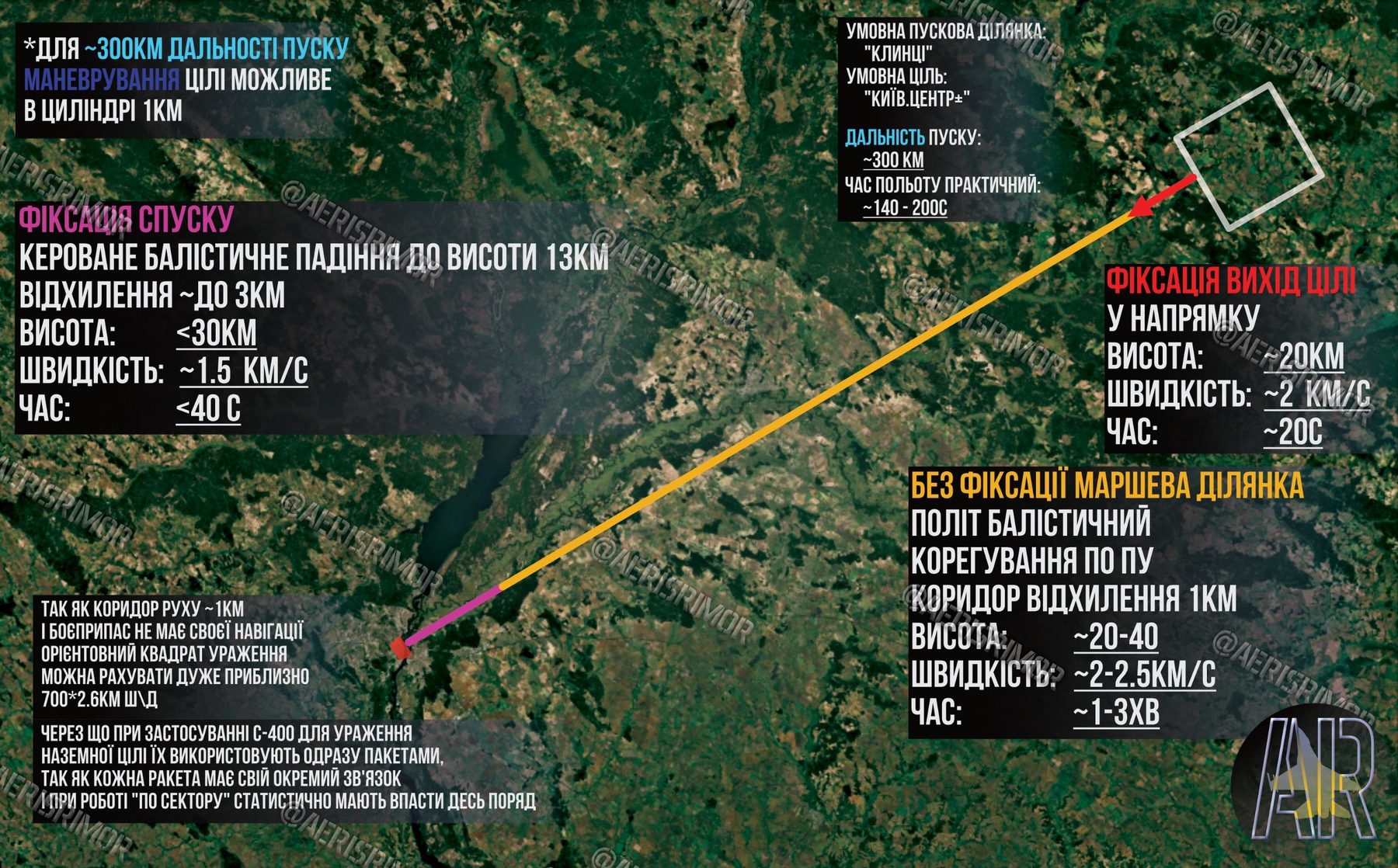
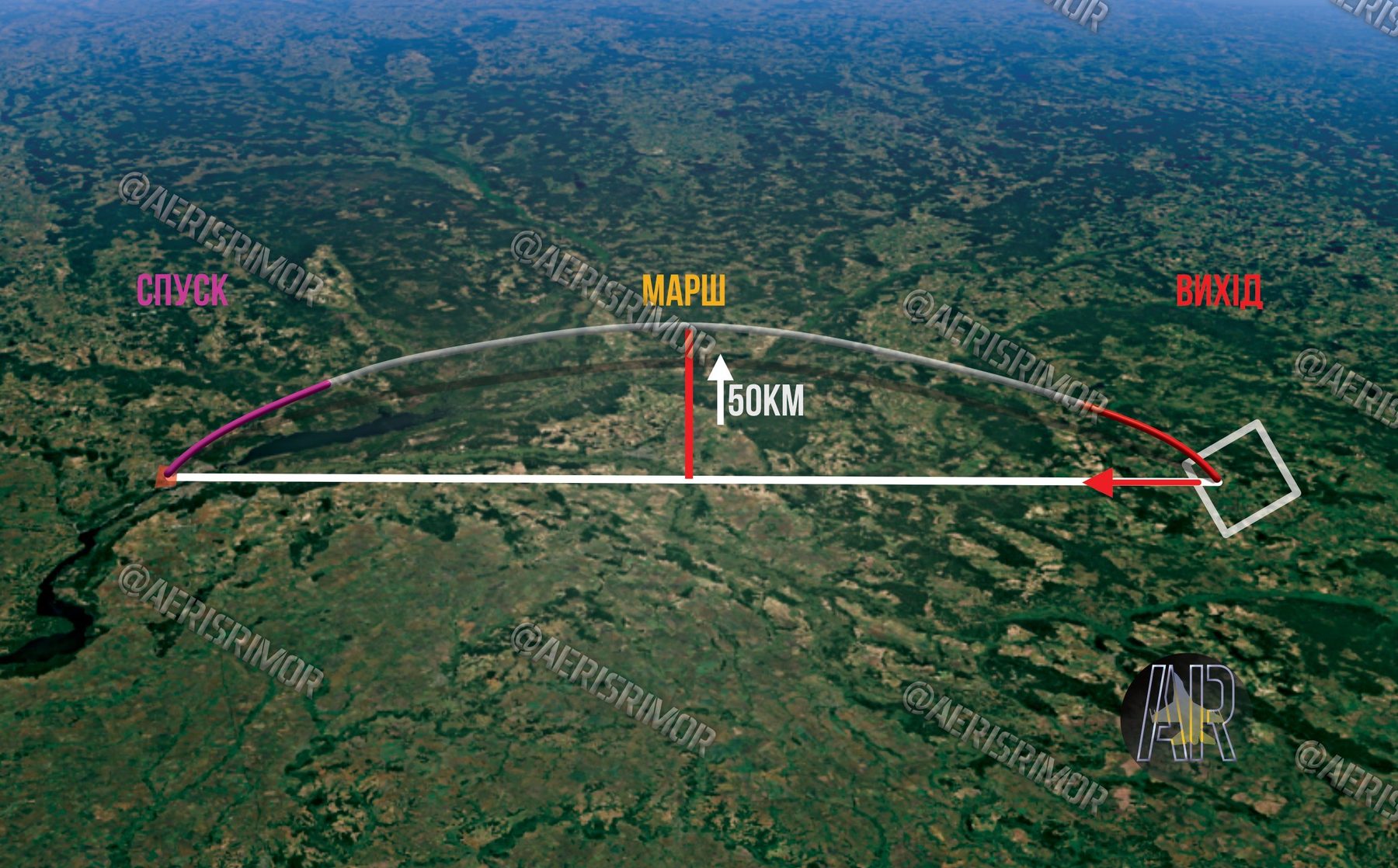
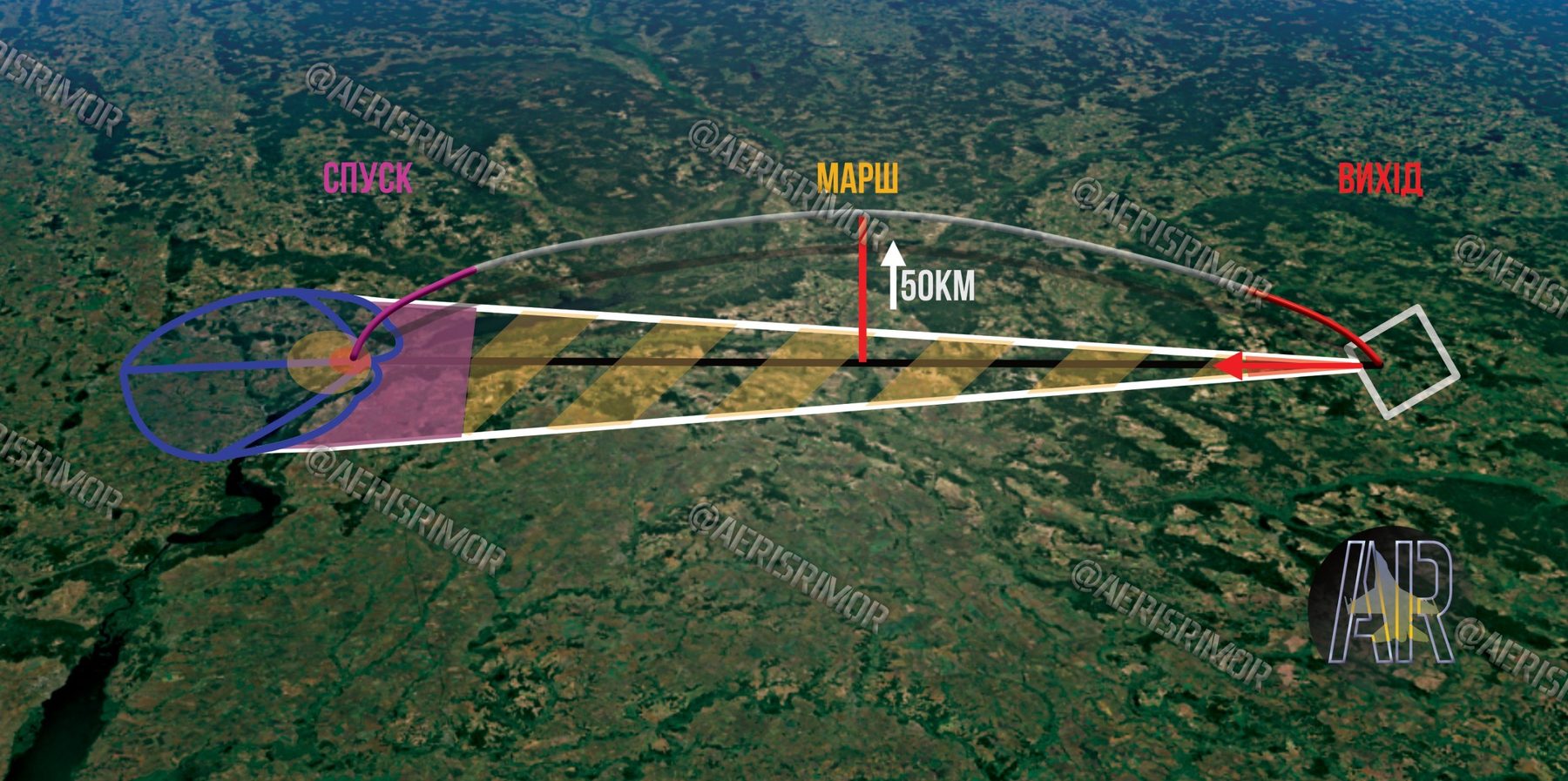
❗️Для Києва окремо розглянемо також сценарій застосування С-400 по землі. Нагадую, що ІЧ-сигнатура там дуже коротка (до 20 с), і часто алгоритм супутникової розвідки пропускає вікно реакції (або пускають спеціально під вікном без супутника).
С-400, на відміну від Іскандера, летить суто математично: ракета «виходить» з контейнера, на «марш» по вже знайомій дузі з 50 км апогею, але ракета практично весь політ керується за допомогою каналу зв'язку з позиції пуску (у ЗКР радіопрозора задня частина корпусу, і вона отримує сигнал з КП). Так як пускова зона Клинці — Унеча знаходиться трохи вище Києва, керуючий сигнал тримає ракету весь час в умовному коридорі діаметром 1 км навіть на частині «спуску».
Так як траєкторія математична, тут можна провести пряму паралель зі «стандартним» математичним режимом Іскандера: найпряміша траєкторія буде швидше, і спуск цілі майже в 2 рази швидше, що робить С-400 складніше для фіксації з землі, бо вона «повертається» зі швидкістю 4+ ккм/год, або 1,2–1,7 км/с.
Під час спуску ракета втрачає керованість на висоті ~13 км по траєкторії польоту до цілі. В умовному коридорі та відхиленні можна враховувати відхилення від реальної цілі в 3 км радіусом.
У разі ідеального виконання траєкторії польоту КВО (відхилення від цілі) у будь-якому випадку буде не менше 700 метрів горизонтально та до 2,6 км еліпсом від точки прицілювання — тобто 1,6 км недоліт, 1,1+ км переліт, бо ціль не має своєї навігації та коригування підльоту, повністю керуючись з КП, з пологим кутом «спуску».
Через що їх майже завжди застосовують одразу повними пакетами — 4 од. на ПУ, кожна ракета має свій сигнал керування з КП. А математична оптимізована траєкторія зменшує час польоту до 140–180 с.
Чернігів чує сонік буми не від прольоту цілей — бо вони у верхніх шарах атмосфери, — а віддзеркалення початкового сонік буму при старті цілі: агресивний набір швидкості передає багато потенціалу з вектором у напрямку Чернігова. А Козелець та Десна чують сонік бум від «Спуску» ракети з апогею в напрямку Києва та агломерації.
❗️For Kyiv, let us look separately at the scenario of an S-400 used against ground targets. A reminder that its IR signature is very short — up to 20 s — and the satellite-reconnaissance algorithm often misses the reaction window (or the launch is deliberately timed for a window with no satellite overhead).
Unlike the Iskander, the S-400 flies a purely mathematical path: the missile “launches” from its canister onto the familiar arc of the “march”, with a 50 km apogee, but for practically the whole flight it is guided over a data link from the launch position (a surface-to-air missile has a radio-transparent rear section and receives the signal from the command post). Since the Klyntsi–Unecha launch area sits slightly north of Kyiv, the control signal holds the missile within a notional corridor 1 km across for the whole flight, including part of the “descent”.
Because the trajectory is mathematical, a direct parallel can be drawn with the Iskander’s “standard” mathematical mode: the straighter the path, the faster it is, and the target’s descent is almost twice as fast. That makes the S-400 harder to detect from the ground, since it re-enters at 4+ thousand km/h, or 1.2–1.7 km/s.
During the descent the missile loses controllability at an altitude of ~13 km along its path to the target. Within the notional corridor and its deviation, one can expect a departure from the actual target of up to 3 km in radius.
Even with a perfectly executed trajectory, the CEP will in any case be no better than 700 m laterally and up to 2.6 km along the aim-point ellipse — that is, 1.6 km short and 1.1+ km long — because the munition has no navigation or approach correction of its own, is controlled entirely from the command post, and comes in at a shallow “descent” angle.
This is why they are almost always employed in full packages at once — four rounds per launcher, each missile with its own control link from the command post. And the optimised mathematical trajectory cuts the flight time to 140–180 s.
What Chernihiv hears is not the sonic boom of targets passing overhead — those are in the upper atmosphere — but the reflection of the initial boom at the moment of launch: the aggressive acceleration transfers a great deal of energy along a vector pointing towards Chernihiv. Kozelets and Desna, meanwhile, hear the boom of the missile’s “Descent” from apogee towards Kyiv and its agglomeration.
08
Зведені числові дані
Summary of the numbers
Іскандер-М
| Етап | Параметри |
|---|---|
| «Вихід» | Ракета злітає з ПУ, ТПРД працює до 60 с, набір швидкості ~3–4 тис. км/год. |
| «Марш» | Рух в атмосфері від 50 км до 130 км висоти в залежності від дальності, зі швидкістю 6,5–7,3 тис. км/год. Коригування супутниковою навігацією, «випадкові» маневри. |
| «Спуск» | Починається з висоти нижче 50 км: ракета сповільнюється, коригується, ухиляється; швидкість знижується до 3,2–4,5 тис. км/год (у залежності від режиму: з коригуванням — швидкість менша, математична — більша). |
- Загальна тривалість польоту: 300 км — 200 с · 400 км — 250 с · 500 км — 300 с
- *Похибка ~30 с
- БЧ унітарна — 500 кг
- БЧ касетна — 54 касети по 0,5 кг, площина ураження 1,5–2,5 га (коло 100 м, до еліпса 200 × 100)
С-400
| Етап | Параметри |
|---|---|
| «Вихід» | Злітає з контейнера ПУ, ТПРД працює до 20 с, набирає ~2,2 км/с, або 7,5 тис. км/год. |
| «Марш» | Рух в атмосфері до 50 км (на максимальну дальність) зі швидкістю 2–2,5 км/с, або 8 тис. км/год. |
| «Спуск» | Починається з висоти нижче 50 км: ракета сповільнюється та настильно математично летить у напрямку цілі зі швидкістю 1,2–1,6 км/с, або 4,2–4,5 тис. км/год. |
- Загальна тривалість польоту: 300 км — 140–180 с
Додатково. Згідно даних, отриманих нами та партнерами, ми отримуємо «Секторальне очікування», через що бувають ситуації з фантомними цілями близь до Чернігова — особливо коли на Брянщині працює ППО. Це так званий «послід»: коли траєкторія і параметри були зафіксовані, траєкторія «повернення» математично йде в наш бік, але сама ціль на той час уже не існує.
Iskander-M
| Phase | Parameters |
|---|---|
| “Launch” | The missile lifts off from the launcher; the solid-fuel motor burns for up to 60 s, accelerating to ~3–4 thousand km/h. |
| “March” | Flight through the atmosphere between 50 km and 130 km of altitude depending on range, at 6.5–7.3 thousand km/h. Correction by satellite navigation, with “random” manoeuvres. |
| “Descent” | Begins below 50 km: the missile decelerates, corrects and evades; speed drops to 3.2–4.5 thousand km/h (depending on mode — lower with correction, higher on the mathematical path). |
- Total flight time: 300 km — 200 s · 400 km — 250 s · 500 km — 300 s
- *Margin of error ~30 s
- Unitary warhead — 500 kg
- Cluster warhead — 54 submunitions of 0.5 kg, effective area 1.5–2.5 ha (a 100 m circle, up to a 200 × 100 m ellipse)
S-400
| Phase | Parameters |
|---|---|
| “Launch” | Lifts off from the launcher canister; the solid-fuel motor burns for up to 20 s, reaching ~2.2 km/s, or 7.5 thousand km/h. |
| “March” | Flight through the atmosphere up to 50 km (at maximum range) at 2–2.5 km/s, or 8 thousand km/h. |
| “Descent” | Begins below 50 km: the missile decelerates and flies a flat mathematical path towards the target at 1.2–1.6 km/s, or 4.2–4.5 thousand km/h. |
- Total flight time: 300 km — 140–180 s
One more thing. Based on the data we and our partners receive, what we get is a “sector expectation”. That occasionally produces phantom targets near Chernihiv, especially when air defence is active over Bryansk oblast. This is the so-called “after-trace”: the trajectory and parameters were recorded, the re-entry path mathematically points our way, but by that time the target itself no longer exists.
09
Джерела та співавтори
Sources and co-authors
Основні джерела:
Primary sources:
- hal.science/hal-03838157v1
- cimss.ssec.wisc.edu/satellite-blog/archives/68950
- spie.org — capturing 3D hyperspectral image cubes for dynamic events
- earth.esa.int — HOTSAT-1
- browser.dataspace.copernicus.eu
- sd-magazine.eu/index.php/sd/article/view/231/171
- ResearchGate — Comprehensive Mathematical Model of the Ballistic Trajectory of an Operational-Tactical Missile
- globe.adsbexchange.com
- war-sanctions.gur.gov.ua
Співавтори: Скринька Пандори · Київський Адмін
Co-authors: Pandora’s Box · the Kyiv admin