Публікації · Основи
Publications · Basics
Особливості балістичної траєкторії
How a ballistic trajectory works
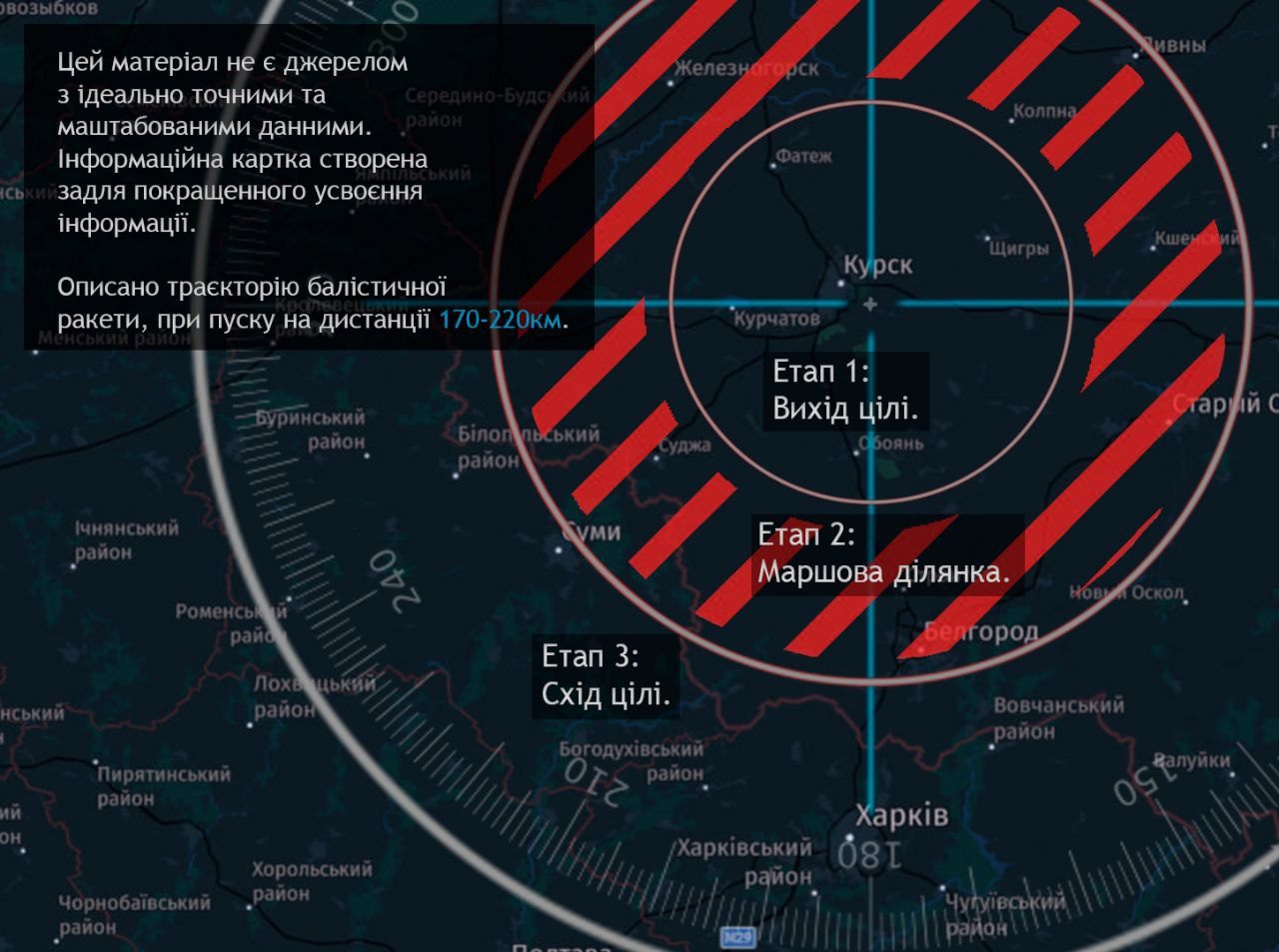
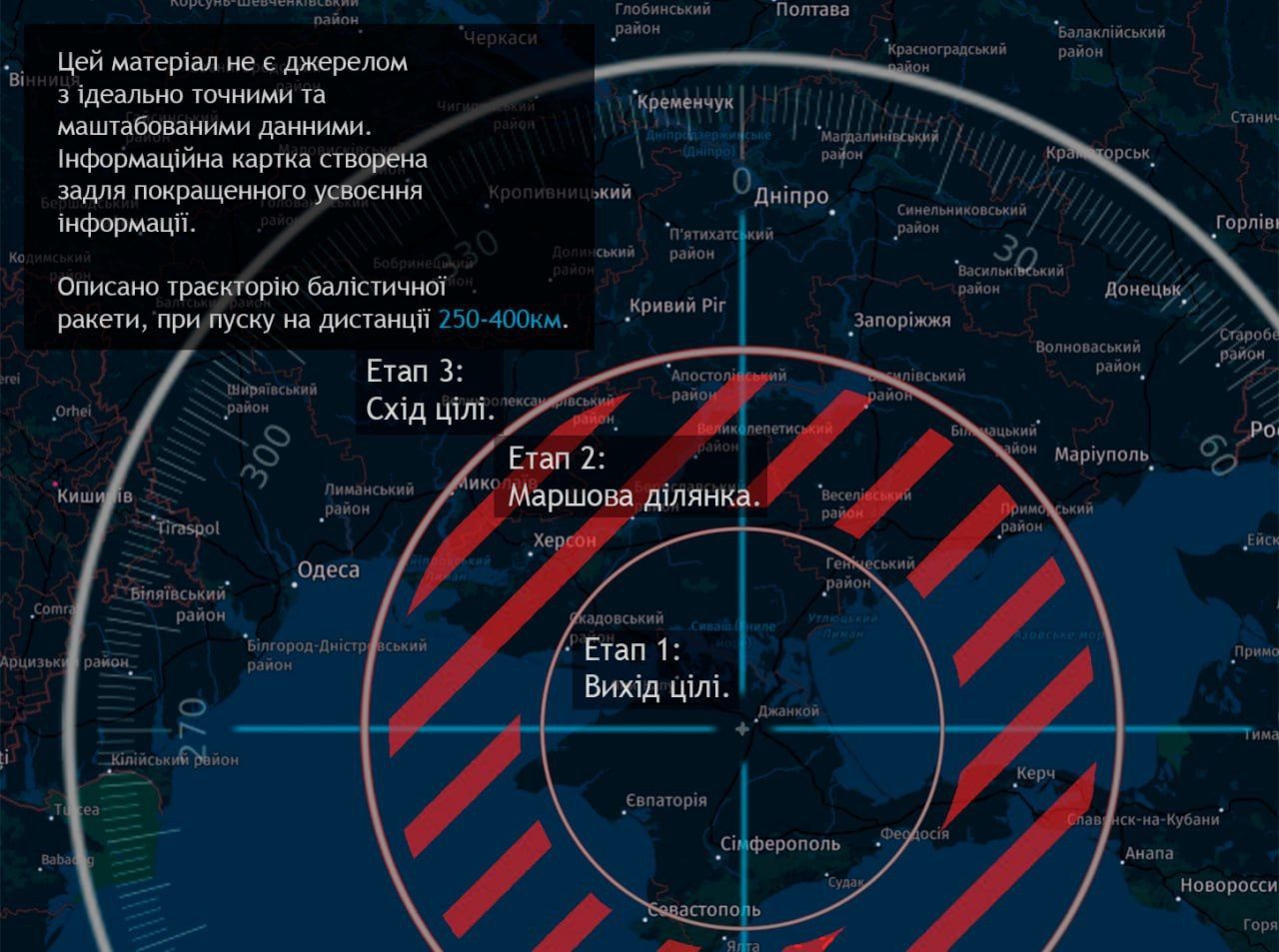
Особливості балістичної траєкторії на 300 км загалом проілюстровані на картинках.
The characteristics of a ballistic trajectory over 300 km are illustrated on the maps below.
Інформаційні картки створені задля покращеного усвоєння інформації.
The info cards exist to make the process easier to grasp.
01
Три етапи польоту
The three phases of flight
- 1️⃣ При виході фіксується «свіча» (протяжністю приблизно ~40 км) у напрямку кінцевої цілі.
- 2️⃣ Далі ракета розганяється та виходить на «маршеву ділянку» в атмосфері до 60 км висотою.
- 3️⃣ Після повторної фіксації «Схід/Спуск» з атмосфери ракета продовжує корегування в пасивному режимі (рулями) та може змінювати кінцеву точку траєкторії в радіусі приблизно 30 км «підскоком» і маневруванням.
На відрізку «свічі» ми фіксуємо приблизно, в яку сторону летить ракета. При виході на «маршеву» ділянку (фіксація польоту практично неможлива) ракета корегує траєкторію, виходить на пікову висоту та під дією гравітації летить вниз по вектору в напрямку цілі — зі швидкістю приблизно 2100–2300 м/с.
Ми не можемо точно сказати, що саме корегує «чудатєхнологія» на піковій точці, але вона використовує різні засоби наведення на ціль: маневрові рулі, сенсори, супутниковий зв'язок.
- 1️⃣ At launch we detect the “candle” — a burn roughly 40 km long, pointing towards the eventual target.
- 2️⃣ The missile then accelerates and enters the “march leg” within the atmosphere, up to 60 km of altitude.
- 3️⃣ After it is picked up again on the “descent” out of the atmosphere, the missile keeps correcting passively (with its control surfaces) and can shift the end point of its trajectory within a radius of roughly 30 km by “hopping” and manoeuvring.
During the “candle” we can tell roughly which way the missile is heading. Once it enters the “march” leg — where tracking is practically impossible — it corrects its trajectory, reaches peak altitude, and then falls under gravity along the vector towards its target, at roughly 2,100–2,300 m/s.
We cannot say precisely what that “wonder technology” corrects at the peak, but it uses a range of guidance means: manoeuvring control surfaces, sensors and satellite communications.
02
Скільки у вас часу
How much time you have
❗️Остання ділянка польоту займає, в середньому, ДО хвилини.
Тому коли є фіксація «Спуску ракети» у вашому напрямку, у вас вкрай мало часу на відповідну реакцію і, залежно від обставин, найкращим варіантом буде лягти на землю за якоюсь перешкодою, щоб захиститись від уламків.
- ❗️Якщо використовується ПУ (пускова) з двома ракетами, то груповий залп проводиться з паузою до 2 хвилин.
- ❗️Розрахунковий час польоту ракети на мінімальну дистанцію (50 км) — 20 с; на максимальну дистанцію (500 км) — 240 с (~4 хв) з моменту пуску.
Щиро дякуємо Дивізіону «ТІВАЗ» за допомогу в написанні цього матеріалу!
Бережіть себе!
❗️The final leg of the flight takes, on average, UP TO a minute.
So when a missile’s “descent” is detected in your direction, you have extremely little time to react. Depending on the circumstances, the best option is to lie down on the ground behind some kind of obstacle, to protect yourself from fragments.
- ❗️If a launcher with two missiles is used, the salvo is fired with a pause of up to 2 minutes between rounds.
- ❗️Calculated flight time at minimum range (50 km) — 20 s; at maximum range (500 km) — 240 s (~4 min) from the moment of launch.
Our sincere thanks to the “TIVAZ” battalion for their help in writing this material.
Take care of yourselves.